The name on the plaque was mine, engraved in brass, sitting six inches beneath a portrait a stranger had just uncovered as though she’d earned the right to touch it.
I need to explain how a woman ends up standing at the back of her own husband’s memorial while another woman weeps at the front, because from the outside it looks impossible, and from the inside it happened one small surrender at a time.
Marcus and I were married for nine years. He served twenty-two, most of it in assignments he couldn’t discuss, and toward the end there was a stretch where his work took him fully out of reach — a posting that came with a new set of rules about what could be said and to whom. When the notification of his death came, it came through channels that kept me at arm’s length, and in the fog of that grief I didn’t fight the strangeness of it. I signed what I was told to sign. I let the base handle the arrangements. I assumed the distance was the price of the life he’d chosen.
What I didn’t know was that a woman named Vivienne Marsh had been busy.
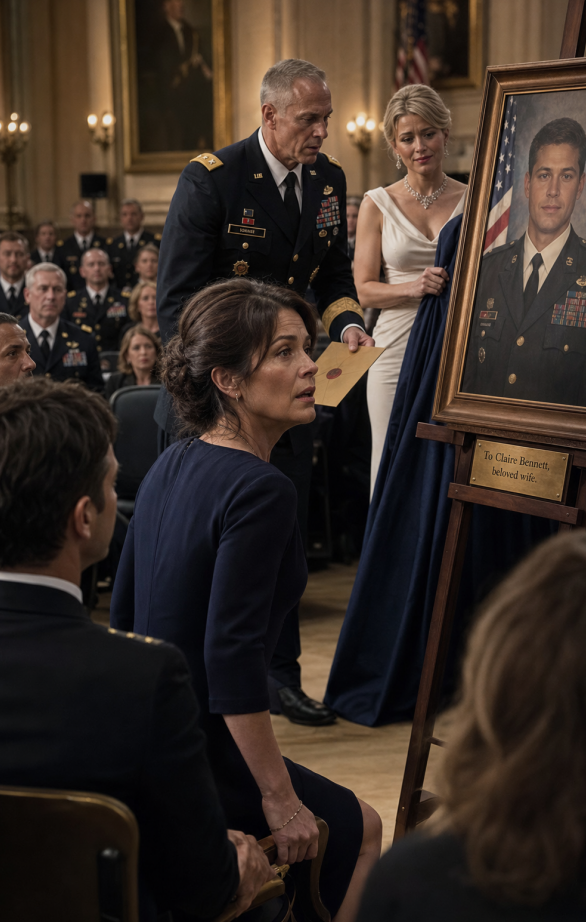
She had been, on paper, his emergency contact for a brief window years earlier, during a deployment before he and I married — an administrative artifact, nothing more. But Vivienne had a talent for turning artifacts into claims. When the death benefits process opened, she filed as his widow. She had just enough real documentation, just enough plausible history, and just enough confidence to make a grieving bureaucracy take her at her word. By the time the base planned the memorial and the portrait dedication, she had inserted herself as the bereaved Mrs. Marsh, and my late invitation and back-row seat were the result of her paperwork, not an oversight.
I didn’t know any of that when I walked into the hall. I only knew that a woman in ivory couture had her hand on the unveiling cord and that the officers were murmuring condolences to her, and that no one seemed to be looking for me. I told myself I must have misunderstood the seating. I told myself I would sort it out quietly after, that Marcus would have hated a scene. So I stood at the back in my navy dress and I watched a stranger pull the cloth from my husband’s face, and I said nothing.
But General Ellison was watching too.
I didn’t know him. I learned later that he’d commanded a unit Marcus served under, that he’d read the actual, sealed service record — not the sanitized version that circulated for the ceremony — and that he had come specifically because something in the paperwork he’d seen did not match the name being honored in the programs. He was a careful man. He did not interrupt the unveiling. He waited until the cloth was down and the applause had faded, and then he stepped forward, and instead of taking Vivienne’s offered hand, he bent to read the small brass plaque bolted to the base of the portrait.
The plaque had been engraved from the official record. From the truth. It named Marcus’s wife, next of kin, beneficiary of record — and the name it carried was mine.
He read it aloud. Just the name, in a flat clear voice that carried to the back of a room built to carry a bugle. And the hall went still in a way I have never heard a room go still, a silence with a shape to it, because two hundred people understood in the same instant that the woman with her hand on the cord and the name on the plaque were not the same person.
General Ellison straightened. He looked past Vivienne — whose careful mournful expression was coming apart at the seams — and he scanned the rows until he found me, half-risen from my seat in the last row, not sure whether to stand or flee. He had a sealed envelope in his other hand, the service record. He asked, quietly, for me to come forward.
I don’t remember walking. I remember the officers turning as I passed, the soft rustle of a whole room reorienting itself. I remember Vivienne’s hand finally leaving the cord. And I remember the general saying, when I reached the front, that the record was unambiguous, that a claim had been filed that the record did not support, and that this would be corrected tonight and in every office that mattered afterward.
Vivienne did not confess dramatically. Fraud rarely does. She simply stopped performing, because there was no longer anyone in the room willing to believe the performance. The benefits claim she’d filed unraveled under the scrutiny that one read-aloud name invited; it turned out she had done a version of this before, and the paper trail, once someone finally pulled it, was not subtle. That is a matter for other people now, in other rooms.
What I keep is smaller and it is mine. It is the memory of an old general who owed me nothing crossing a marble floor to read a name off a plaque because he could not stand to see the record lie in front of him. It is the fact that my husband’s actual last act, administratively, had been to make sure that whatever fog descended, whatever paperwork blurred, the record beneath his portrait would carry me. And it is the quiet I finally felt, standing at the front where I should have been all along, no longer the woman at the back of her own grief.
They rehung the programs with the correct name. The portrait stayed. And beneath it, in brass, is the name Marcus made sure would be there — the four syllables a decorated stranger read aloud to give me back a night, and a truth, that another woman had almost stolen.
Comments are closed.