The two men came up the gangway in dark suits, and the whole deck watched them, because by then everyone had stopped laughing and started to feel that the ground had shifted under the party.
Victoria was still holding her empty wine glass. The red was still spreading across the teak by my sandals. And she was starting to understand that she’d made a mistake, though she didn’t yet know how large.
Let me back up, because the sandals matter.
My name is Marcus, and I made my money in a very unglamorous corner of finance: marine lending. I finance boats. Big ones. Yachts, sport-fishers, the floating status symbols that people who confuse net worth with worth like to park where everyone can see them. It is not exciting work, but it taught me something about people. A man will lie to his wife, his banker, and himself, but he cannot lie to a boat. The boat costs what it costs. The slip fees come every month. And when the money underneath the lifestyle starts to rot, the boat is where you see it first.
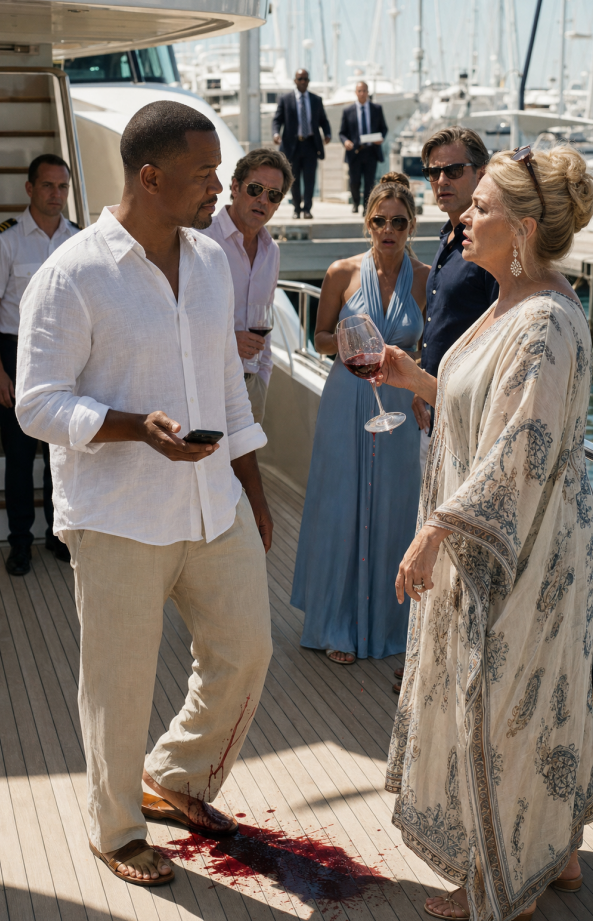
The yacht at that party was one of mine. Not mine to enjoy — mine to hold the note on. Victoria’s family had financed it through my firm three years earlier, at the top of their arc, when everything they touched still looked like it was working. Since then the payments had gone from prompt, to late, to a series of increasingly creative excuses, to nothing at all. They were, in the language of my business, in default. They had been for a while. They just kept throwing parties on the collateral, because to people like Victoria, appearances aren’t a luxury, they’re the whole strategy.
I’d come to the marina that day to take possession. Quietly, I’d hoped. My plan was to board, verify the vessel, meet the marina manager, and let my team handle the paperwork while the family was given a dignified chance to hand over the keys. I don’t enjoy the ugly part of my work. I dress plainly and I keep my voice down and I try to let people keep what dignity they have on the worst financial day of their lives.
I did not expect a party. I did not expect Victoria.
She saw me come aboard in my linen shirt and my flat sandals and she made an instant, total judgment: staff, at best; a nobody who’d wandered up the wrong gangway, at worst. And because she was the kind of host who runs on other people’s discomfort, she decided I’d be the afternoon’s entertainment.
“You,” she said, sweeping over with her glass. “I don’t think you understand where you are.” And then, for the crowd: “People like you get confused about this world. This isn’t a place for you. You should go.” And she tipped her wine over my feet, slow and deliberate, so everyone could see the little man being put in his place.
The deck laughed. That practiced, cruel, follow-the-leader laugh. A deckhand — one of the marina’s, not the family’s — went rigid, because he knew who I was and could see exactly where this was heading. One guest, an older man, lowered his glass and stopped smiling; he’d read the situation half a second before the rest.
I have been underestimated my whole career. It stopped stinging a long time ago. Mostly now it’s just information — when someone shows you they think you’re nothing, they’re telling you precisely how they treat people they don’t need.
So I didn’t argue. I took out my phone, pulled up the document I’d come aboard to execute, and turned the screen toward her.
“This is a notice of default and repossession,” I said, quietly enough that she had to stop talking to hear me. “On this vessel. I hold the note. It’s callable, and I’m calling it. Those two gentlemen coming up the gangway work for me.”
I watched it land. I watched the sneer curdle. I watched her glance at the men in suits, then at the deckhand who’d gone pale, then back at me, and finally do the arithmetic she should have done before she poured wine on a stranger’s feet.
“People like me,” I said, “own the boat.”
What happened next was not dramatic, because I don’t do dramatic. My team came aboard, presented the paperwork to Victoria’s husband — who had been hiding belowdecks avoiding exactly this — and began the orderly process of taking possession. The party dissolved the way parties do when the host’s world visibly ends: quickly, quietly, with a lot of people suddenly remembering somewhere else they needed to be.
Victoria didn’t apologize. People like her never do; an apology would require admitting the man they mocked was real. She just watched her guests file down the gangway past the two men in suits, and somewhere in there the empty wine glass finally slipped out of her hand and rolled across the teak she no longer owned.
I let her keep her dignity where I could. I always do. I gave the family the same window I give everyone — time to remove personal belongings, a chance to settle things without a scene in front of a marina full of onlookers. It’s more than most of them extend to the people who work for them, but I’ve never seen the point in matching cruelty with cruelty. The boat comes back either way. The only choice is how you carry yourself while it does.
The yacht sold within a month to a family who pays on time and, as far as I know, has never poured a drink on anyone.
I still don’t dress up. I still wear the flat sandals. And every so often, at some marina, someone looks at the plain man in the linen shirt and decides he’s a nobody who’s confused about where he is.
I’ve learned to just smile and let them find out.
Comments are closed.