Wade Coleman opened his eyes.
I had my hand halfway to my son’s collar to pull him back, already forming the apology, already doing the math on how fast we could pack, because a job like this one doesn’t come twice to a woman with my resume and a three-year-old and no husband to fall back on.
But Wade wasn’t looking at me. He was looking at Micah, at the fat brush still in my son’s fist, at the crooked rainbow drying on his own weathered cheek, and his face was doing something I had never seen it do in the six weeks I’d worked in that enormous, silent house.
It was crumpling.
“Why’d you do that, son?” Wade asked. His voice came out rough, like it hadn’t been used gently in a long time.
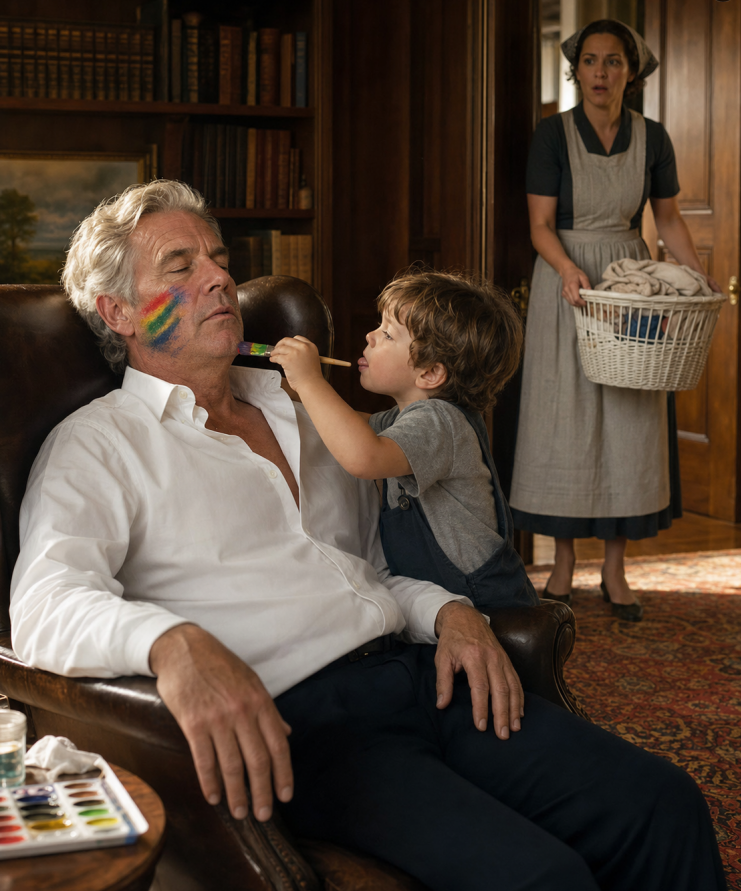
Micah, who has no fear because he’s three and the world has not yet taught him to have any, said it exactly the way he’d told me in the hall an hour before: “You looked sad. So I made you pretty.”
I want to tell you what I didn’t know when I took that job.
I didn’t know that Wade had faked being asleep on purpose. I found that out later, and it should have made me angry — he’d been testing me, waiting to see if I’d go through his desk, pocket something, slack off the second his eyes closed. His lawyers had apparently told him to run “trust checks” on every new hire. Three housekeepers before me hadn’t lasted a month.
I didn’t know that his cardiologist had told him, two weeks earlier, that his heart was a ticking problem and that the stress he lived inside was going to kill him before anything else got the chance.
I didn’t know that the reason the house was so cold and so quiet and so full of beautiful things no one ever touched was that Wade had spent forty years being useful to people who only ever wanted the use of him — a wallet, a name, a signature, an angle. He’d built a mansion specifically so he could be alone in it, because alone was the only place no one was working an angle on him.
And into that fortress walked a woman he was sure would rob him, and her small son painted a rainbow on his face because he thought the rich man looked sad.
Wade didn’t fire me. He sat up in that leather chair with washable paint on his cheek and he laughed — a startled, cracked sound, like a door opening in a house that’s been shut up for the winter — and then, embarrassingly for both of us, he cried. Just for a second. Then he wiped his face, smearing the rainbow, and asked Micah if he wanted to see the “big fish” in the pond out back.
That was the beginning.
Here is what I’ve learned about that man since. Everything he owns, he earned, and every person who ever got close to him wanted a piece of what he earned, and so he’d stopped letting anyone close at all. He’d confused being needed with being loved so many times that he’d decided to stop being either. He kept the paint on his cheek for the rest of that day, by the way. Wouldn’t let me wipe it off. Said it was the first thing anyone had put on him in years that they didn’t want anything back for.
We never left that house.
Not because Wade offered us money — though he did, he doubled my pay and set up something for Micah’s future that I’m still not sure I’ve fully wrapped my head around. We stayed because a man who had armored himself against the whole world got outflanked by a three-year-old with a paintbrush, and instead of rebuilding the armor, he let it stay down.
Micah calls him “Mr. House Man” because he can’t manage “Coleman.” Wade has that phrase engraved on a little plate on his study door now, under his real name. He got the heart procedure his cardiologist wanted — he’d been refusing it out of a kind of spite at the world, and he told me, plainly, that he changed his mind because “somebody around here would notice if I didn’t come back.”
The house isn’t quiet anymore. There are toy cars on the marble stairs and finger-paintings taped in a hallway that used to hold only appraised art, and an old man who learned, at fifty-eight, that the difference between being used and being loved is whether the person reaching for you wants to take something or give it.
He set a test to catch a thief. What caught him instead was a little boy who looked at a hard, tired stranger and decided the kindest thing he could do was make him pretty.
That’s the whole story. That’s why we stayed. And it’s the closest thing to a happy ending I ever expected to get.
Comments are closed.