Margaret Ellsworth’s hands stayed flat on that tablecloth while I finished the will. Clause by clause. I didn’t rush. I’ve learned that the quiet, even recitation of a document is far more frightening to certain people than any raised voice could ever be.
“…and the residuary estate,” I said, “to be held in trust, with the grandchildren named as beneficiaries specifically excluded by the codicil dated the fourteenth of March.” I set my empty silver tray on the edge of her table. “Would you like me to continue to the witness signatures, Mrs. Ellsworth? Or shall we discuss why neither witness was in the state that week?”
The country club had gone the specific kind of silent that only very wealthy rooms achieve — the silence of people who have never once been told no, discovering that something is happening they cannot control.
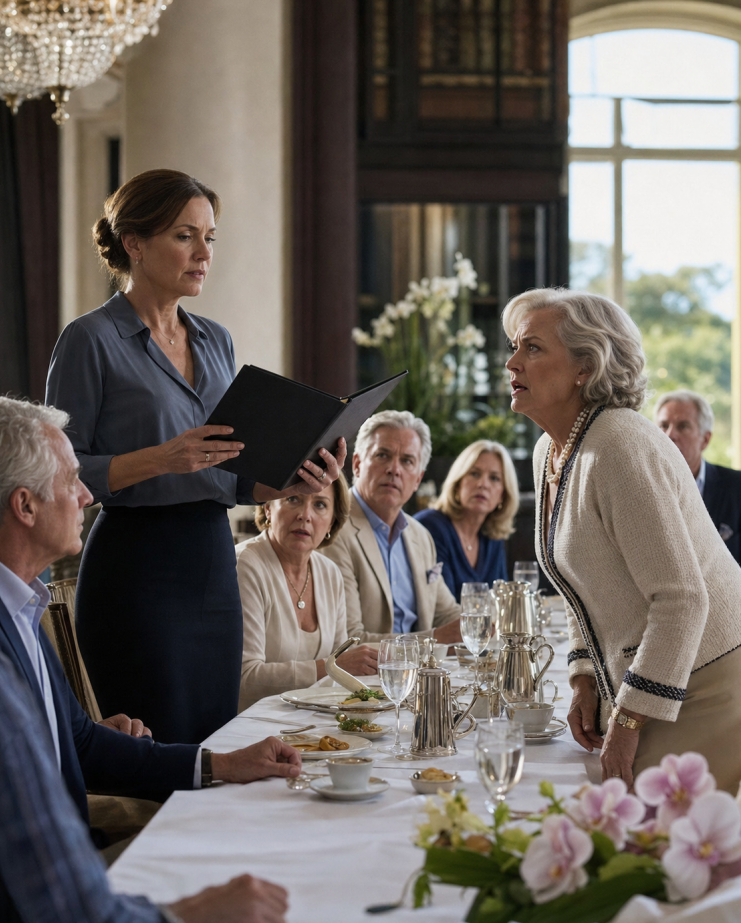
Margaret’s friends were staring at me now with the expression you’d give a chair that had started reciting poetry. The “simple” tea server. The girl too dim to fold a napkin.
Here is what none of them knew.
Three of Margaret Ellsworth’s grandchildren had come into a probate firm four weeks earlier, quietly, terrified, with a copy of a will they were certain was fraudulent. Their grandmother had, on paper, cut them out entirely in favor of a “charitable foundation” whose sole director was a man named Curtis Fenn — Margaret’s financial adviser of the last three years, a man who had gotten very close, very fast, to a wealthy widow’s affairs.
The signature on the disinheriting codicil was Margaret’s. Sort of. It matched the way a tribute band matches a song. Close enough for a notary who wasn’t looking. Wrong enough for anyone who was.
I’m not a tea server. I’m a probate investigator, and I go where the fraud is. Sometimes that’s a records office. This time it was the Ashford Country Club’s Tuesday luncheon, in a uniform, close enough to watch how Margaret Ellsworth behaved when she thought the help couldn’t understand her — because the question my clients needed answered wasn’t just whether the will was forged.
It was whether Margaret knew.
And for three weeks, I’d watched a proud, sharp, cruel old woman who did not act at all like someone slowly giving her fortune away on purpose. I’d watched Curtis Fenn steer her, isolate her, “handle” her paperwork. I’d watched her sign things he slid in front of her without reading them, because he’d made himself the one person she trusted to read them for her.
She wasn’t the villain of this story. She was the mark. And the cruelest part — the part I actually felt something about, standing there in that ridiculous uniform — was that her isolation was partly her own doing. A woman that unkind to the people beneath her ends up surrounded by no one but the person clever enough to flatter her. Fenn had simply walked into the empty space that decades of contempt had cleared for him.
“Mrs. Ellsworth,” I said, more gently than she deserved. “Did you know that your grandchildren were removed from your estate?”
Something flickered across her face. Confusion. Then the first, dawning edge of fear that had nothing to do with me.
“That’s not — ” she started. “The foundation is a tax matter. Curtis handles the — the foundation is temporary, he explained it, it’s a — ” She stopped. I watched her hear herself. I watched her realize she was quoting a man, word for word, about documents she’d never actually read.
“The foundation names Curtis Fenn as sole director with full discretion over the assets,” I said. “There is nothing temporary about it. And your grandchildren are not beneficiaries. They are expressly excluded.”
The flute of iced tea beside her hand was sweating a ring onto the linen. One of her friends, a woman named Delphine who had laughed loudest at the napkin joke, reached over and took Margaret’s wrist, and for once there was nothing cruel in the room at all — just old women realizing that the thing they’d all feared, the polished stranger who gets too close to the money, had happened to one of them at that very table.
The reckoning didn’t happen at the club. Those things never do. It happened over the following months, in offices, with the report I filed and the handwriting analysis and the two witnesses who admitted under questioning that they’d signed a blank page as a “favor” to Mr. Fenn. It happened when the codicil was thrown out, when the foundation was unwound, when Curtis Fenn stopped returning anyone’s calls and then stopped being reachable at all.
The grandchildren got their inheritance back. That’s the part my clients paid for, and we delivered it.
But there’s a part they didn’t pay for that I think about more.
Near the end, once it was all settled, Margaret Ellsworth asked to meet me. Not the tea server — me, in my actual clothes, with my actual card. She sat very upright in her diamonds and she looked at me for a long moment.
“You could have let me lose everything,” she said. “God knows I was rude enough to earn it.”
“You were,” I agreed. “That’s not the same as deserving to be robbed.”
She almost smiled. Almost. Old habits.
“I still don’t know how to fold a napkin properly,” I told her, and I left her there, in the club where she’d once decided I was too simple to matter, holding the one thing Curtis Fenn had never counted on the help being able to read.
Comments are closed.