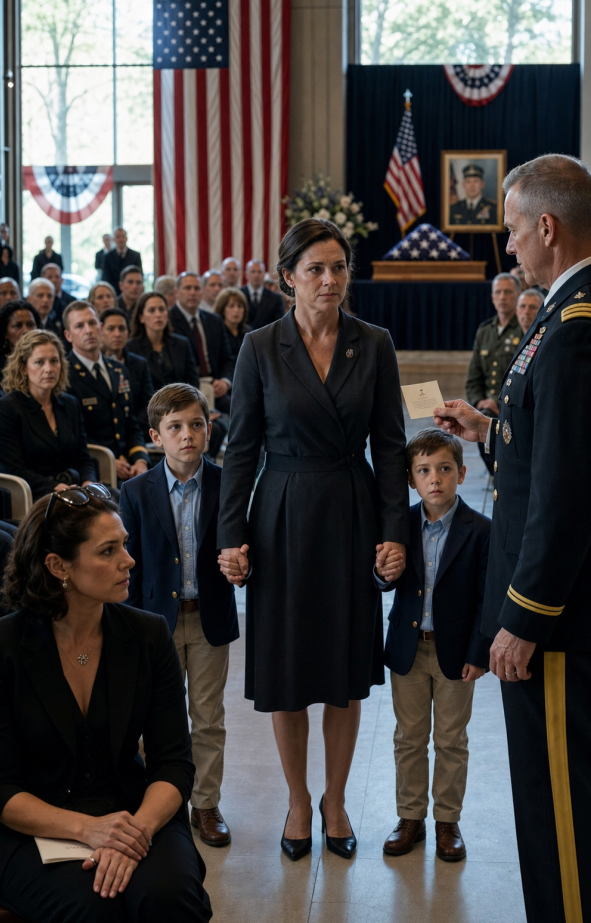
Colonel Mercer held the reservation card up so the front rows could see it, and he read the name printed on it in a flat, carrying voice that did not leave room for argument.
“Renee Calloway,” he said. “Next of kin.”
Then he looked down the length of that flag-draped hall, past the woman sitting in the front chair in her couture and her dark glasses, all the way to the back where I stood with a twin’s hand in each of mine, and he said, “Ma’am, this is your seat. And your sons’.”
I want to go back to how I ended up at the back of my own husband’s memorial, because I’ve had people ask how a wife lets that happen, and the answer is that it happens one small surrender at a time.
David and I had been married eleven years. He was quiet about his work in a way I’d learned not to push on; he’d tell me when he could, and mostly he couldn’t. His family never approved of me. His mother, Diane, had decided early that I was beneath the Calloways — I taught fourth grade, I didn’t come from anything, and when the twins came she found a hundred small ways to make clear she thought David had married down.
When the notification came that David had been killed, I fell apart the way anyone does. And in the weeks after, while I was underwater, his family took over. They planned the memorial. They chose the hall, the speakers, the order of service. I let them, because I could barely stand up, and because some part of me still believed grief would make them kind.
It didn’t. Three days before the service, Diane called and told me it would be “less complicated” if the boys and I sat “somewhere less prominent.” She said there would be press, colleagues, people David worked with, and it would be “smoother” if the family presented a united front without “distractions.” I was so hollowed out I didn’t even fight it. I said okay.
What she didn’t tell me was who would be sitting in the front chair.
I found out when we arrived. There was a woman I had never seen in my life seated in the place reserved for the widow — poised, elegant, dark glasses, accepting the low murmured condolences of David’s colleagues like she’d earned them. Diane was beside her, guiding people to her, calling her by a name I didn’t catch. When I tried to move toward the front with the boys, an usher — one of David’s cousins — stepped in and told me the front was “reserved,” and steered us to the back.
I stood there with my sons and I thought: I will not make a scene at his funeral. For an hour I held that line. Marcus, my quieter twin, kept looking up at me, trying to understand why we weren’t up front with the picture of Daddy. I didn’t have an answer that a seven-year-old could hold.
And then, near the end, a man in Army service dress stood up from the reserved row.
I didn’t know Colonel Mercer. I learned afterward that he had served with David, that he had come to pay respects to a man he’d trusted with his life, and that he had arrived expecting to find David’s wife in the front row and had instead found a stranger. He’d been watching the whole service with a growing wrongness he couldn’t place. What finally moved him was small: he glanced at the little printed reservation card on the empty adjoining chair, the one meant for the “spouse,” and the name on it wasn’t the name of the woman sitting there.
The name on it was mine. Because whatever Diane had arranged for show, the official paperwork — the one the military honored — could only carry one next of kin, and that was me.
Mercer picked up the card. He asked, quietly, for the woman in the front chair’s name. And when the answer didn’t match, he stood, and he read my name aloud, and the whole hall turned.
I later learned the woman was a family friend of Diane’s — not a con artist in the movie sense, but a placeholder Diane had installed to keep the “unsuitable” widow and her ordinary children out of the photographs, with vague talk of “handling the benefits” that Mercer’s presence made impossible. There was a classified briefing document, one David had filed, that named me his emergency contact and next of kin in plain language. Diane’s arrangement had no standing against it at all.
Mercer walked the length of the aisle, and he offered me his arm, and he escorted me and my two boys to the front of the room while three hundred people watched. He seated Marcus on one side of me and Eli on the other. Then he stood at the head of the aisle, faced the folded flag, and saluted my husband properly, in front of everyone, on behalf of the wife the family had tried to erase.
Diane didn’t look at me for the rest of the service. She couldn’t. She had built a careful little stage to keep me in the shadows, and a man who’d actually known David had walked in and, with nothing but a name on a card, turned every light in the room toward the chair that was always mine.
My boys don’t remember the back of the room now. They remember being walked to the front. They remember a colonel saluting their father. I decided that was the version they’d get to keep.
Comments are closed.