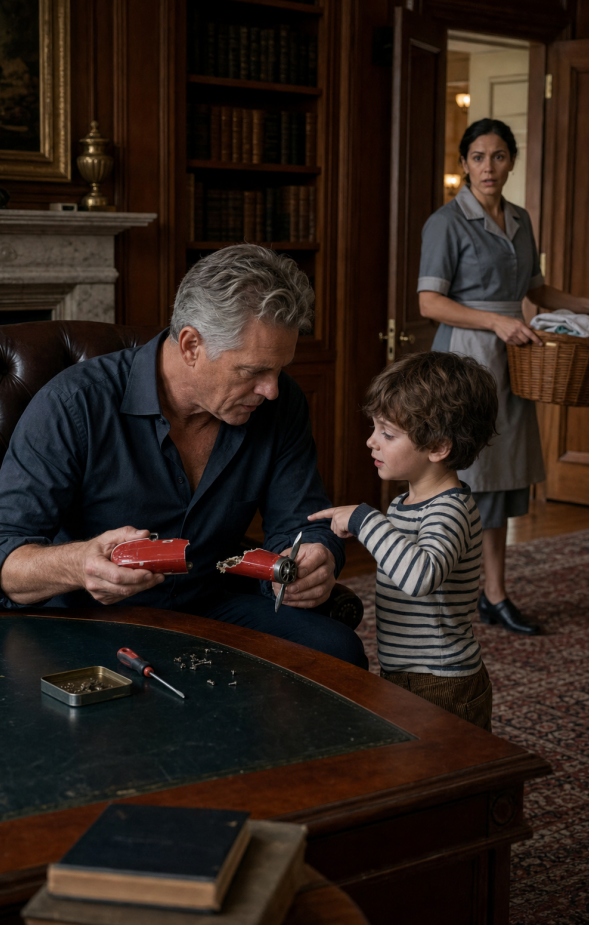
I fixed the plane in about four minutes. A drop of glue on the snapped wing, the propeller reseated, a tiny screw I had to fish out of a drawer I hadn’t opened in a decade. Miles watched the whole thing with his chin on the edge of my desk, breathing through his mouth, absolutely certain it would work because the House Man was doing it.
When the propeller spun free and clean, he made a sound — this pure, delighted whoop — and threw his arms around my neck before I could do anything about it. His mother, still frozen in the doorway, actually gasped.
I have negotiated the acquisition of companies that employed thousands of people. I have stared down men who wanted to destroy me and watched them blink first. And I am telling you that no deal, no victory, no number on any statement, ever landed in my chest the way that boy’s arms did.
I need to explain what kind of man I was before that afternoon, so you understand why a fixed toy plane broke something open in me.
I built Vance Industrial from a single failing foundry into one of the largest privately held manufacturing firms in the country. I did it by being the coldest person in every room. My father taught me that warmth is a liability — that the moment people know you can be moved, they own you. It worked so well that by sixty I had everything a man could buy and not one person on earth who wanted to be in a room with me.
My wife left twenty years ago. My son and daughter are grown and they are polite to me the way you’re polite to a creditor. They email my assistant. They come at Christmas, stay ninety minutes, and leave. I told myself for decades that this was the price of building something great, and that I’d paid it willingly.
Then Lena Ortiz came to keep house, and she came with a six-year-old, and the six-year-old was not afraid of me.
That was the thing I couldn’t get over. Everyone is afraid of me. My board is afraid of me. Miles was not. He’d wave at me in the hallway. He’d leave me drawings on the stairs — crayon buildings with “VANCE” spelled wrong across the top, because he’d decided the tall buildings downtown were mine, “the House Man’s houses.” I never responded. I also, I noticed, never threw the drawings away.
The day he brought me the plane, his mother was certain she was about to be fired. I could see it. She’d told him a hundred times not to bother me, and he’d wandered into my study anyway, and she was already composing her apology, already doing the math on how fast she could find another position with a kid in tow.
And I looked at her face — that specific fear, the fear of a person one bad moment away from losing everything — and I recognized it. Because I put that fear on people’s faces for a living. I’d just never been on this side of it, watching a good woman brace to be punished for her child’s trust.
So I fixed the plane. And then, because Lena was still standing there terrified, I said the truest thing I’d said in years: “He’s not bothering me. He’s the best part of my week.”
It became a ritual after that. Miles would bring me things to fix — a wheel off a truck, a dinosaur missing a leg, a music box that had stopped playing. I started keeping a little kit in my desk drawer. I started, God help me, looking forward to three o’clock, when school let out and I’d hear those sneakers on the marble.
He asked me things no one had asked me in years. Why I ate dinner alone. Whether the big buildings were lonely at the top. Whether I had a mom. Children ask the questions adults have learned are too dangerous, and answering them, I found out things about myself I’d spent forty years not looking at.
I started changing things I didn’t announce to anyone. I called my daughter — not through my assistant, myself — and asked if I could see my granddaughter, whom I had met exactly twice. There was a long silence on the line. Then she said, in a careful voice, “Who is this really?” That’s what I’d made of my own child: someone who couldn’t believe her father would call just to see her.
We’re rebuilding. Slowly. It’s awkward and I’m bad at it and I say the wrong thing constantly. But I’m in the room now. I keep showing up.
The turning point came the day Lena knocked on my study door with her coat already on and her resignation in an envelope. Her sister two states over was ill; she needed to go help, and she couldn’t do it and keep a live-in position here. She was apologetic, professional, already gone in her mind.
And the thought of that house without those sneakers on the marble — I can’t describe it except to say it felt like a light going out.
I didn’t accept the resignation. I offered her the guest wing instead — the whole east side of the house, rooms Miles could actually run in — and told her to bring her sister to recover here, that I’d cover the care, that there was more room in this house than one cold old man could ever use and it was absurd for it to sit empty while a family I’d come to need slept somewhere smaller.
She cried. I nearly did, which would have been a first in front of another adult.
They stayed. Lena’s sister got well in the east wing. Miles has a proper room now, painted like a hangar because he’s decided he wants to fix real planes someday.
My son noticed the change before he understood it. “You seem different,” he said, warily. I told him a six-year-old fixed me with a broken toy, and he laughed, thinking I was joking, then saw that I wasn’t.
I spent sixty-three years believing my father was right, that warmth was a weakness that let people own you.
He was half right. Warmth does let people own you. Miles owns a piece of me now, and Lena, and my granddaughter, and slowly my own grown children again.
I just had the ledger backwards my whole life. That isn’t the cost of a good life. That is the good life. And I nearly missed all of it because I couldn’t spare four minutes and a drop of glue.
Comments are closed.