I gave the baby a name before I left the hospital that day. I named her after her mother. And then I made a phone call that ended the merger, the career, and the man I’d spent forty years becoming — and I have never once regretted it.
Let me tell you what happened after the nurse said that word. An hour.
I stood in that ICU waiting room holding a sleeping infant, and my phone was buzzing against my chest — the lawyers, the board, the merger that was ninety minutes from signing, the deal I’d sacrificed every relationship in my life to build. And I looked down at the baby’s face, at the jawline I shave every morning, and something in me that had been frozen solid for a very long time simply cracked and let go.
The nurse — her name was Gloria, I’d learn, and she was kinder to me that day than I deserved — walked me to a small private room. She told me what she could. The mother’s name was Amara. We’d met at a conference in Denver eleven months earlier. One week. We’d agreed it was nothing, and I’d flown home to my empty penthouse proud of how clean I’d kept it. What I didn’t know was that Amara had gotten pregnant, and had decided — for reasons I’ll never fully understand and have made a strange peace with — not to tell me until the baby came. She’d carried it alone. She’d routed the medical bills through my corporate billing office, some quiet insurance against the day she’d finally reach out, and a billing clerk had paid them without ever flagging them to me, because that is how large and impersonal the machine I built had become.
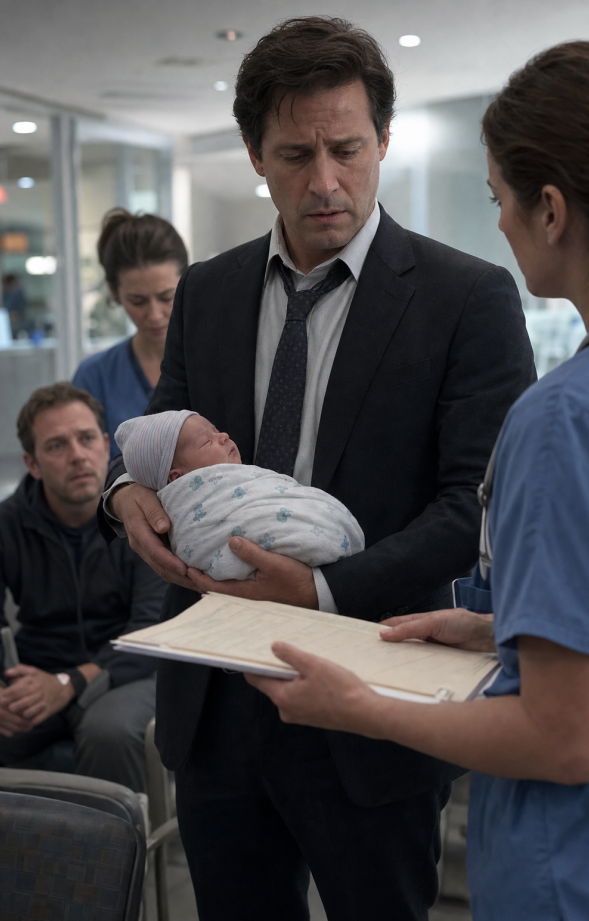
She’d gone into labor early. Complications. She’d made it through the delivery and then, an hour before I arrived, she hadn’t. She’d left instructions with the hospital: if anything happened, call him. He’s the father. His name is on the bills. And she’d left a letter, which Gloria handed me in a sealed envelope, and which I could not open in that room and did not open for three days.
The baby had no one else. Amara had no family they could find. And there I was — the emergency contact by default, the blood match by luck, the father by a truth I’d spent eleven months not knowing.
I made two phone calls from that little room.
The first was to my head of legal. I told him to pull me out of the merger. Not delay — pull. He thought I’d lost my mind. Forty years of work, the biggest deal of my life, ninety minutes from close, and I was walking away with no explanation. I gave him none. I just said the word no and hung up, and I felt something I hadn’t felt in decades, which was free.
The second call was to Gloria’s colleague in the hospital’s social services office, to start — that very hour — the process of establishing paternity and taking my daughter home.
Because she was my daughter. The blood test that had found me proved it beyond any doubt. And in the space of one afternoon I went from a man who had arranged his entire life to need no one, to a fifty-six-year-old first-time father sitting in a hospital learning how to hold a bottle from a nurse who kept having to remind me to support the head.
I named her Amara. After her mother. It felt like the only honest thing I had to offer — that the child would carry the name of the woman who chose to have her, who carried her alone, who thought enough of me despite my silence to write “he’s the father” on a form when her own life was ending.
I read the letter three days later. I won’t share all of it; some things a man keeps. But I’ll tell you the line that undid me. She wrote: “I didn’t tell you because I didn’t want you to come out of duty. I wanted to see if you’d come at all. I’m sorry I won’t get to know which man you turned out to be. But I think you’re better than you let yourself be. I’m betting her whole life on it.”
She bet her daughter’s whole life on a man she’d known for one week, on the theory that I was better than the life I’d built suggested.
I have spent every day since trying to be worth that bet.
The merger fell apart, of course. My walking away at the final hour cost the company a great deal and cost me my reputation as the closer who never blinked. The board pushed me out within the year. Once, that would have been the end of my world — my identity was the deals, the wins, the empty tower with my name on it.
Now I have a four-year-old who calls me Dada and cannot pronounce her R’s and believes, with total confidence, that I am the strongest man in the world because I can open the pickle jar. I sold the penthouse. We live in a house with a yard now, a normal house, and there are crayon drawings on my refrigerator instead of quarterly projections, and I coach — badly — a soccer team of five-year-olds on Saturday mornings.
People from my old life think I lost everything that afternoon in the ICU. A merger, a company, a legacy.
They have it exactly backwards. I lost a life that was slowly killing me, and I gained the only thing I ever built that will outlast me. Her name is Amara. She has my jaw and her mother’s stubborn heart, and every night when I check that she’s breathing before I go to sleep — a thing I cannot stop doing — I say a quiet thank-you to a woman I knew for one week, who saw something in me I couldn’t see, and bet her daughter’s whole life that she was right.
Comments are closed.