The photograph in the file was my husband.
Not a younger man who looked like him. Not a brother I’d never heard of. Him. Michael. The man I’d married in a church with peonies, the man who taught Mia to ride a bike, the man I had buried in the ground two years ago on a grey Tuesday. His face, a little heavier, the beard new, but him, stapled to a document with a seal at the top that I would later learn belonged to the United States Marshals Service.
The man in the grey jacket lunged for the file, but it was too late. I’d seen it. Mia had seen it. And the cook behind the pass-through had stopped pretending, one hand braced on the steel counter like the floor had tilted under him.
“Rosa,” he said.
My name. He said my name in my dead husband’s voice, and my knees nearly went out from under me.
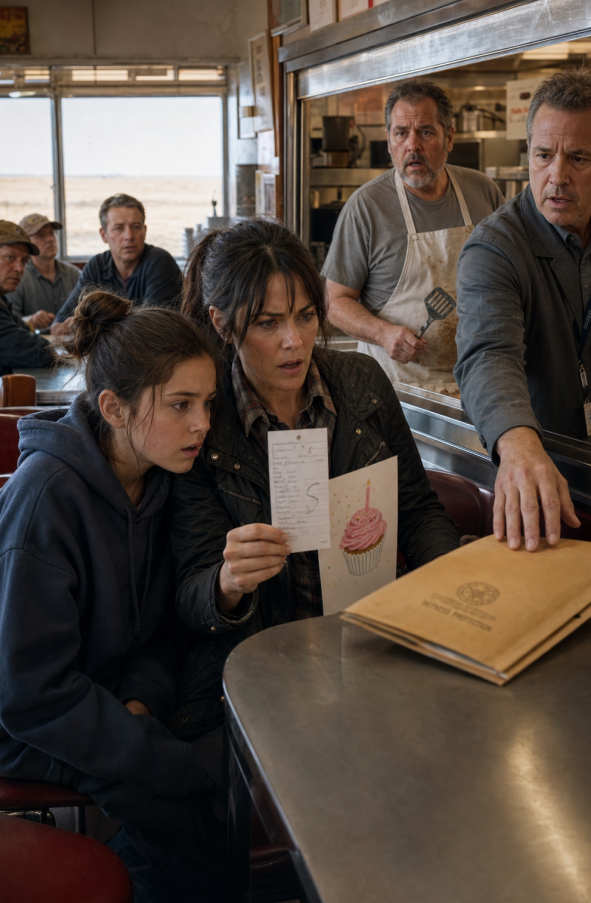
I’m going to tell you the rest the way it was explained to me over the following weeks, in a windowless federal office with a lawyer on one side and a marshal named Doyle on the other, because in the diner itself all I could do was hold onto my daughter and shake.
Michael had not died in the accident we buried him for. Michael had been a bookkeeper for a freight company, and over three years he had quietly assembled a record of everything that company was really moving across state lines, and the people it belonged to. When he brought that record to the FBI, he became the single most important witness in a case against a criminal organization that does not forgive being testified against.
The government offered him a choice. Testify and enter witness protection, or stay and almost certainly be killed, and put me and Mia in the crosshairs with him. He chose the one that he believed kept us alive. And the cover story they built, the one that let a marked man disappear completely, was a death. A staged accident. A closed casket I never thought to question because who questions the worst day of their life.
He did not get to tell me. That was the part I could not forgive, at first. He let me grieve. He let Mia grieve. He stood, I later learned, at the back of the cemetery in a borrowed coat and watched his own funeral from a distance because he could not stay away, and then he vanished into a town in Kansas with a new name and a job flipping eggs, and he wrote his checks with the same backward looping ‘S’ he’d written his whole life, because that one small thing he could not train out of his own hand.
The marshal, Doyle, was furious. We were never supposed to be there. It was a one-in-a-million accident of a road trip and a highway exit and a hungry eleven-year-old. Michael was supposed to be untraceable, and instead his wife and daughter had walked into his diner and ordered pancakes.
Here is what I have made my peace with, and what I have not.
The organization Michael testified against was dismantled last year. The threat, the marshals say, is effectively gone. Which means the wall between us has started, slowly, carefully, to come down. It is not simple. You do not get back two years. Mia is angry in the way only a girl who lost her father twice can be angry, once to a grave and once to the truth. There are counselors. There are supervised visits that are becoming less supervised. There is a man learning how to be a father to a daughter who is now taller than the last time he held her.
But I think about that check on the chrome counter, that stupid looping ‘S’, and I understand that he never really left us. He signed his love into every receipt he ever wrote, in the one piece of himself he couldn’t disguise, as if some part of him was always writing to us, hoping.
Mia keeps the birthday card in her backpack still. But now she has new ones. This year’s is on the fridge, the ‘S’ looping backward, and under his new name he signed it the old way. “Love, Dad.” Some things a man cannot change even to save his own life. I’m grateful, now, that he couldn’t And every month, when I visit that granite headstone with his name still carved into it, I no longer feel like I am talking to the dead. I feel like I am keeping a secret for a man who is very much alive, and finally, slowly, coming home.
Comments are closed.