On election night across America, millions of anxious citizens gathered around their television screens, refreshing dashboards and waiting for the definitive verdict of the democratic process. Within ninety minutes of poll closures, one of the nation’s largest and most fiercely contested states delivered a complete, crystal-clear, and unquestionable result.
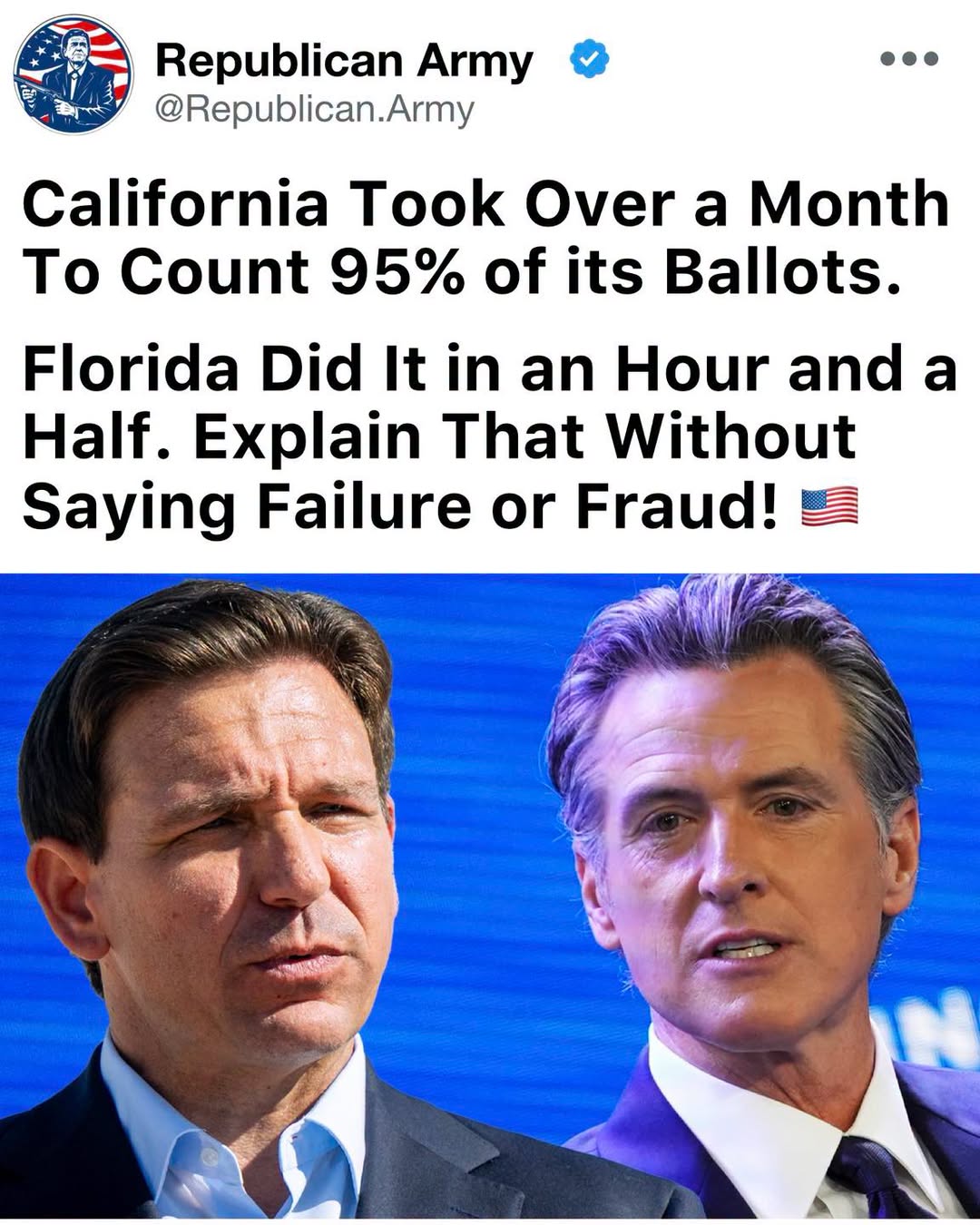
That state was Florida, where election officials processed, tabulated, and certified more than eleven million ballots before most families had even finished their evening dinner. There was no lingering ambiguity, no endless trickle of mystery precincts, and zero doubt about the will of the voters.
Meanwhile, nearly three thousand miles away, the nation’s most populous state embarked on what has become an agonizingly predictable bureaucratic nightmare. Weeks after the first ballots were cast, California was still struggling to cross the ninety-five percent threshold, leaving critical congressional seats and local initiatives hanging in limbo.
The contrast could not possibly be clearer, sharper, or more damning for the architects of modern bureaucratic delay. What we are witnessing is not a harmless logistical quirk, but a fundamental divide in how governance, efficiency, and public trust are valued across state lines.
For years, apologists for slow-counting states have leaned on a tired playbook of excuses, claiming that geography, immense populations, and complex ballot measures make rapid results an impossible dream. Florida permanently obliterated that narrative, proving that precision and speed are simply matters of political will and administrative competence.
Consider the staggering mechanics of Florida’s election night operation. With nearly twenty-two million residents spread across sixty-seven counties, Florida represents a massive, highly diverse, and politically complex battleground that handles astronomical voter turnout.
Yet, when the 7:00 PM and 8:00 PM deadlines struck across the state’s two time zones, county election supervisors did not wait days to unpack mailed ballots or debate processing standards. Florida law allows election workers to begin canvassing and processing mail-in ballots up to a month before Election Day itself.
By the time the physical polls closed on Tuesday evening, millions of early and absentee votes had already been securely scanned, verified, and loaded into encrypted databases. All it took was the push of a button to instantly report millions of verified votes to a waiting public.
Compare that seamless, high-tech execution to the agonizing crawl unfolding along the Pacific Coast. In California, state regulations permit ballots postmarked by Election Day to arrive up to a full week later, dragging out the initial collection phase before verification can even realistically conclude.
County workers in Los Angeles, Orange, and Alameda counties find themselves buried under mountains of universal mail ballots, manual signature reviews, and lengthy curing periods that extend well past Thanksgiving. The result is an excruciatingly sluggish process that paralyzes the political landscape for more than a month.
When elections drag on for weeks without resolution, the real casualty is not just convenience—it is public confidence in our core institutions. A protracted counting period creates an information vacuum that inevitably breeds skepticism, confusion, and partisan acrimony across the political spectrum.
Every day an election outcome remains unsettled, everyday citizens are left wondering why a nation capable of split-second global financial transactions cannot calculate paper ballots in real time. Florida understood this psychological reality and built an election architecture specifically engineered to deliver instant transparency.
The Sunshine State was not always a beacon of administrative perfection. The nation vividly remembers the chaotic recount of 2000, when hanging chads, conflicting judicial orders, and county-by-county disparities brought the entire republic to a standstill.
Instead of wallowing in excuses or institutional paralysis, Florida’s state leadership embarked on a multi-decade mission to overhaul its election infrastructure from top to bottom. They listened to voters, reformed outdated statutes, invested heavily in cutting-edge voting technology, and instituted uniform standards across every single precinct.
Under decisive state leadership in recent years, those reforms were accelerated and solidified with strict safeguards and clear, enforceable operational deadlines. Florida eliminated ambiguity by enforcing strict voter identification, securing ballot drop boxes, and mandating that vote-by-mail ballots must be received by poll-close on Election Day.
 Police arrest Geordyn Hayes in daughter Saylor’s death: ‘directed search efforts away from the nearby body of water’
 When Anti-Police Rhetoric Collides with Reality: Florida Woman Sentenced to 20 Years After Violent Attack on State Trooper
 The LLC Socialist: Inside the $1.5 Million Brooklyn Mansion Exposing DSA’s Gilded Hypocrisy
Building the Gold Standard of Election Integrity
The core philosophy driving Florida’s system is elementary: make voting accessible, make security airtight, and make the count immediate. By setting high standards and demanding total accountability from county supervisors, Florida transformed itself from a national punchline into the undisputed gold standard of modern election management.
“Quick counting means transparency and public trust, without the drawn-out uncertainty that plagues other places. Americans want election results they can believe in right away.”
The excuse that California is simply “too large” to report rapid election results collapses under basic mathematical scrutiny. Florida has a population roughly sixty percent the size of California, yet Florida reports its totals nearly thirty times faster than its West Coast counterpart.
Furthermore, other large states with massive, sprawling populations—such as Texas, Florida, and Ohio—manage to deliver overwhelming majorities of their vote totals within hours of poll closures. The prolonged counting cycle in California is not a product of natural law; it is a direct consequence of policy choices and bureaucratic complacency.
By mailing out active ballots to every single registered voter regardless of whether they requested one, California creates an enormous operational bottleneck. The state’s lax processing rules force local workers to spend weeks sorting, validating, and hand-processing millions of returns long after the national conversation has moved on.
This prolonged limbo does real, tangible damage to the legislative branch of the federal government. Control of the United States House of Representatives has repeatedly hung in the balance for weeks at a time simply because key California swing districts could not finish counting their votes.
While newly elected lawmakers from Florida and other efficient states are already arriving in Washington for freshman orientation, California candidates are left sitting on their hands, unable to staff offices or prepare to serve their constituents. This administrative lag sidelines voters and disenfranchises communities from immediate representation.
The demand from the American public is neither partisan nor unreasonable. Whether a voter casts their ballot for the left, the right, or the center, every citizen shares an urgent desire for clarity, fairness, and finality on election night.
When results are delivered immediately, winners can be declared with undeniable legitimacy, losers can graciously concede, and the nation can begin the essential work of governing and healing. When results linger in uncertainty, suspicion naturally festers and hardens into lasting cynicism.
The path forward for state legislatures across the country is already mapped out in bright, undeniable detail. Lawmakers do not need to reinvent the wheel or commission endless bureaucratic studies when a working blueprint is actively functioning in Tallahassee.
States that genuinely care about restoring voter confidence must adopt Florida’s pre-canvassing policies, allowing mail-in ballots to be processed and verified well before the polls open. They must establish strict deadlines requiring all ballots to be in hand by the time polling locations close on Election Day.
They must invest in robust, modern tabulators and establish uniform signature verification standards that leave no room for arbitrary local interpretation. Most importantly, election officials must be held strictly accountable to the public they serve, with state oversight ensuring that every county operates with peak professional efficiency.
The American republic was founded on the fundamental principle that governments derive their just powers from the consent of the governed. That consent is expressed through the sacred act of voting, and it deserves an administrative system that honors the gravity of the vote.
Florida has drawn a distinct line in the sand, demonstrating that modern democracy can be fast, secure, and transparent all at once. The era of accepting month-long delays, bureaucratic foot-dragging, and administrative incompetence as business as usual must come to an immediate and permanent end.
The contrast between Florida’s triumph and California’s stagnation provides a definitive wake-up call for the entire nation. It is time for every state in the union to follow Florida’s lead, clean up their election machinery, and deliver the timely, trustworthy results the American people deserve.
No Comments yet!