Her name was Lily. I know that now. That night, all I knew was that a small girl in a secondhand red coat was standing in my donor line holding a crayon sign that said VOTE DAD, and my first thought — God forgive me — was that someone had sent her to destroy me.
That’s what a campaign does to your brain. You stop seeing children. You start seeing liabilities, optics, the next attack ad. My whole staff had drilled it into me: assume every unusual thing is a trap. So when the crowd parted and I saw that little cardboard sign wobbling above her head, my stomach dropped, and I actually leaned toward my chief of staff to say get her out before the cameras find her.
I’m not proud of that. I’ll never be proud of that.
The security detail was already moving. A staffer crouched to steer her toward the exit with that fake-warm smile they train you to use. And the girl — she didn’t cry, didn’t cling. She just lifted her other hand, and in it was a folded piece of paper, and pinned to her coat was something small and laminated that caught the light.
I told them to stop. I don’t know why. Something in the shape of her face.
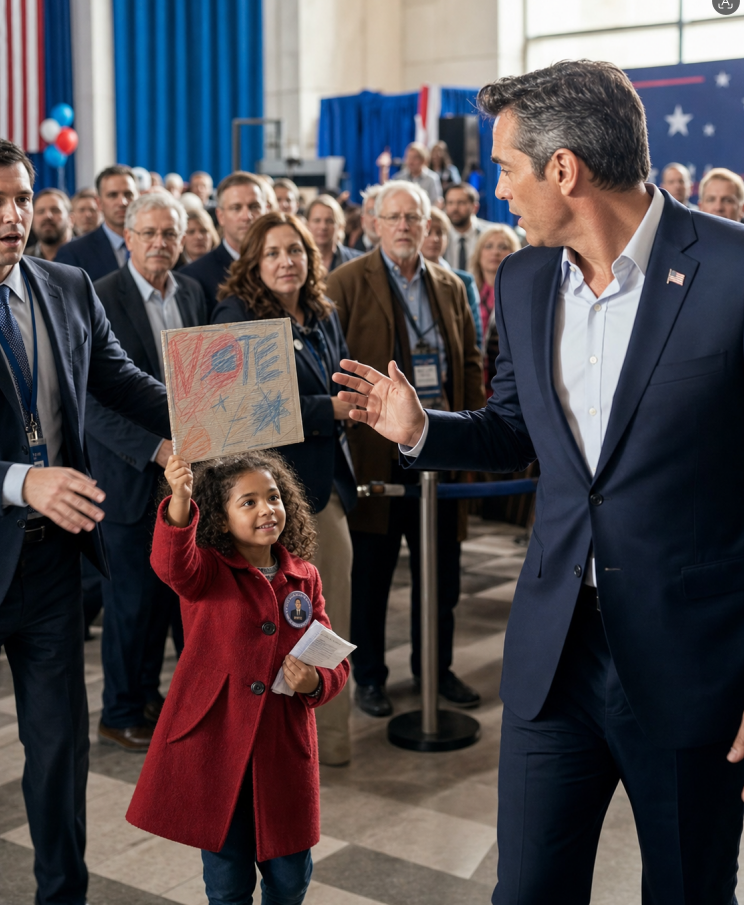
I crossed to her myself, and up close I saw what the badge was. It was an old campaign volunteer credential — my first race, the long-shot one nobody thought I’d win. My name was printed across the top in a font we’d stopped using years ago. And under the plastic, in the little photo window where a volunteer’s picture should go, was a snapshot of a woman I had spent four years trying not to think about.
Her mother.
Dana ran my volunteer operation back when the whole thing was folding tables and cold coffee. She was the best I ever had — relentless, funny, the kind of person who made exhausted people want to knock on one more door. And I fired her. I fired her because a story reached me that she’d lied about being pregnant to get sympathy and leave, and I was young and terrified of scandal and I believed the worst without asking a single question. I told her to clear out her desk. She looked at me like I’d struck her, and she left, and I told myself I’d done the responsible thing.
I never saw her again. I assumed she’d moved on, gotten angry, gotten over it.
I knelt down on the floor of that rally, in front of the cameras I’d been so afraid of, and I asked the little girl her name.
“Lily,” she said. “My mom said if I ever got lost, I should find you. Because you’re my dad.”
The note in her hand was in Dana’s handwriting. I knew it instantly — I’d read a thousand of her volunteer memos. It was short. It said she was sorry to do it this way. It said she hadn’t lied about anything, that Lily was born seven months after I let her go, that she’d tried twice to reach me and been screened out by the very staff standing around me now. And it said she couldn’t protect Lily anymore where she was, and that she trusted me to, and that she was sorry, and that she had to disappear.
The last line said: Ask the marshals. They’ll explain what I can’t.
It took my lawyers three days to piece it together, and even then only in fragments, because the rest is sealed. Dana hadn’t vanished out of spite. After she left my campaign she’d stumbled onto something — a man, a scheme, the details don’t belong in a Facebook post — and she’d done the brave thing and testified. Witness protection took her the night before Lily appeared at my rally. She had one window to place her daughter somewhere safe before she was gone for good, maybe forever. And the only person she trusted, the man who’d thrown her away without a hearing, was standing on a stage two miles from where they’d been hiding.
She could have punished me. She could have gone to a reporter and ended me with a sentence. Instead she pinned an old badge with her face on it to her daughter’s coat, so that when the moment came, I would have to look at her and know.
The DNA test was a formality. I knew before the swab. Lily has my mother’s eyes and my father’s stubborn chin and a gap where her front teeth used to be, and when she smiles the whole architecture of my face rearranges itself on hers.
I suspended campaign events for a week. My advisors said it was suicide. Let them. I’d spent years learning how to win rooms, and I’d just met the one person I couldn’t afford to lose, and she was six and she’d been taught to find me if she ever got lost.
Lily lives with me now. It wasn’t simple — there were hearings, and a guardianship, and long careful conversations with people whose job is to make sure a senator doesn’t just get to keep a child because it’s convenient. But her mother’s arrangement had named me, and the paperwork Dana left behind was meticulous, the way her volunteer files had always been. She’d planned this down to the badge. She’d planned it knowing she might never see the result.
I think about Dana every day. I think about the version of me who signed her termination without asking why she was crying. I’d like to tell you I’ve made peace with it. I haven’t. Some debts you can’t pay to the person you owe. You can only pay them forward to whoever they left behind.
I don’t know if she’s alive. The nature of where she went means I may never know. But there’s a folder my office keeps, sealed, that will go to Lily when she’s old enough — everything I could legally gather about who her mother was and what she did. The bravest person I ever fired.
Lily asked me last week why I looked sad at her school play. I told her I was thinking about someone who’d love to be here. She nodded like she understood, and she does, more than a six-year-old should.
She still has the sign. VOTE DAD, in yellow crayon. I had it framed. It hangs in my office where the poll numbers used to.
They never got me a single vote. They got me my daughter.
Comments are closed.