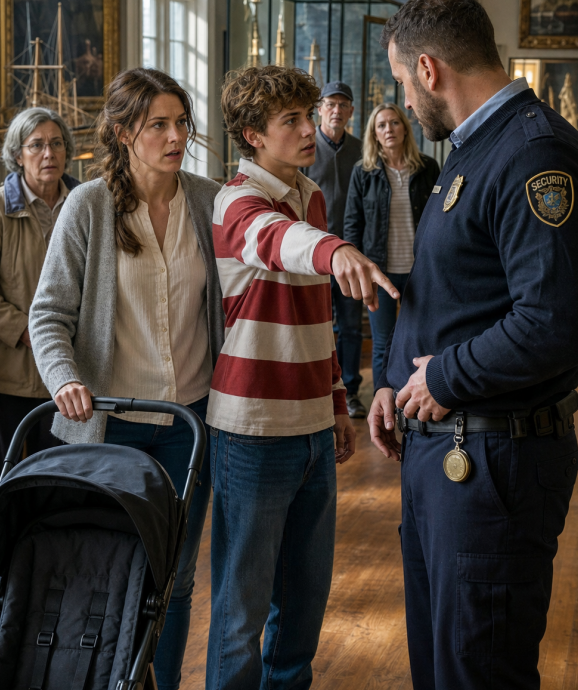
The guard’s name tag said RAY. My husband’s name was Ethan.
But I knew before he ever opened the compass. You don’t share a bed with a man for six years and fail to recognize the exact way his shoulders drop when he’s cornered. Ray had Ethan’s shoulders. Ray had Ethan’s hands, even under the beard, even with the extra weight and the buzzed hair and the two years of a life I hadn’t been part of.
A supervisor came over when she saw the crowd forming. I think she expected to smooth over an argument about a lost item. Instead she found a shaking woman, a pointing toddler, and a security guard who couldn’t speak. I asked her, as calmly as I could manage, to please have him open the compass. I said it might belong to my late husband. I said the word “late” and watched the man flinch.
He opened it.
Inside the lid, scratched in by hand years ago, were the initials E.J.C. and a date — the date Ethan’s grandfather had given him the compass, the day of Ethan’s commissioning. There is exactly one of those compasses on this earth. I had watched it go into an empty casket. And here it was, warm from a stranger’s belt, in a museum ninety miles from the coast where they told me the sea had taken him.
He didn’t run. I’ll give him that. He asked the supervisor for a moment. He crouched down to Milo’s level, and our son looked at him with the fearless certainty of a child who was simply, obviously right, and Ethan’s face came apart.
We talked in the museum cafe while Milo ate crackers and swung his legs, blissfully unaware that he’d just detonated our entire lives.
The accident was staged. All of it. Ethan had gotten in deep — gambling debts that started small and metastasized into something owned by people who don’t send letters, they send visits. He owed money to men who hurt families to make a point. And in his mind, the math was simple and insane: if he was dead, they had no reason to come after me and Milo. A drowned man can’t pay, and a drowned man’s widow is just a sad story, not a lever.
So he arranged to disappear off a dive boat in bad water, paid the right people to muddy the search, and walked into a new life two states inland. New name. New job. A quiet, small existence built entirely on the belief that we were safer believing he was gone.
He said he watched us. From a distance. He’d driven past Milo’s daycare once and had to pull over because he couldn’t see through his own crying. He said he told himself every day that grief was survivable but the alternative wasn’t.
I understand the logic. I do. I even understand the love buried somewhere underneath it. But understanding a thing is not the same as forgiving it, and it is nowhere near the same as trusting it again.
Because here is what he didn’t get to decide: he decided for me that a lie was kinder than a truth. He decided that I would rather bury a husband than protect one. He took two years of my life — the memorial, the therapy, the nights I taught our son to say goodnight to a photograph — and he spent them on a plan I never agreed to.
The debts, it turns out, had largely been resolved a year ago. The men who scared him moved on, got arrested, lost interest. For the last twelve months there was no real danger at all. There was just a man who had built a new life and found it easier to keep living it than to come home and face what he’d done.
That’s the part I can’t get past. Not the fear. The comfort.
We’re not together. I don’t know yet if we ever could be. There are legal knots I’m still untangling — a death that wasn’t a death makes a mess of everything from our marriage to our bank accounts. There will be lawyers. There may be charges; faking a death to defraud isn’t nothing.
But Milo has a father now. A real one, with a heartbeat, who has to actually show up. Ethan is in family counseling with us, sitting across a room from the son who found him. Milo doesn’t understand any of the adult wreckage. He just knows the man with the compass is Papa, and he was right all along, and he tells everyone.
I keep the compass now. Ethan gave it to me in the cafe, pressed it into my hand, and I let him. It sits on my dresser, lid closed over those initials.
I take my son to that museum sometimes. He likes the ship models. And I stand near the brass and the old boats and think about how a three-year-old saw the truth in half a second that a whole Coast Guard search never found.
Children don’t know what’s supposed to be impossible. They just point at what’s real.
Comments are closed.