The seal stamped into the corner of that leather portfolio was the same one my father pressed into wax on every deed he ever signed, and Devin had seen it a hundred times without once asking what it meant.
My father built things. Not glamorous things — he assembled land and buildings the slow, unglamorous way, one parcel at a time, over thirty years, holding them in a family trust he ran like a fortress. When I married Devin, my father took him aside and told him, kindly, that the trust was mine and would always be mine, that I was its sole director, and that a marriage did not change the shape of a thing built to outlast marriages. Devin nodded the way men nod when they’ve already decided a woman’s money is a technicality that will sort itself out in their favor.
He never checked. That was the whole of his mistake, and it was a big one. In nine years he never once read the paperwork on the home he lived in, never wondered why the maintenance staff greeted me by name in the lobby, never asked why the building’s holding company had my family’s initials worked into its very name. He decided early that I was decorative — the quiet wife who’d married up, who cooked and kept out of his business and would be lost without him. He built his entire sense of himself on that story, and I let him, because grief and habit and a marriage you’re still trying to save will make you smaller than you are.
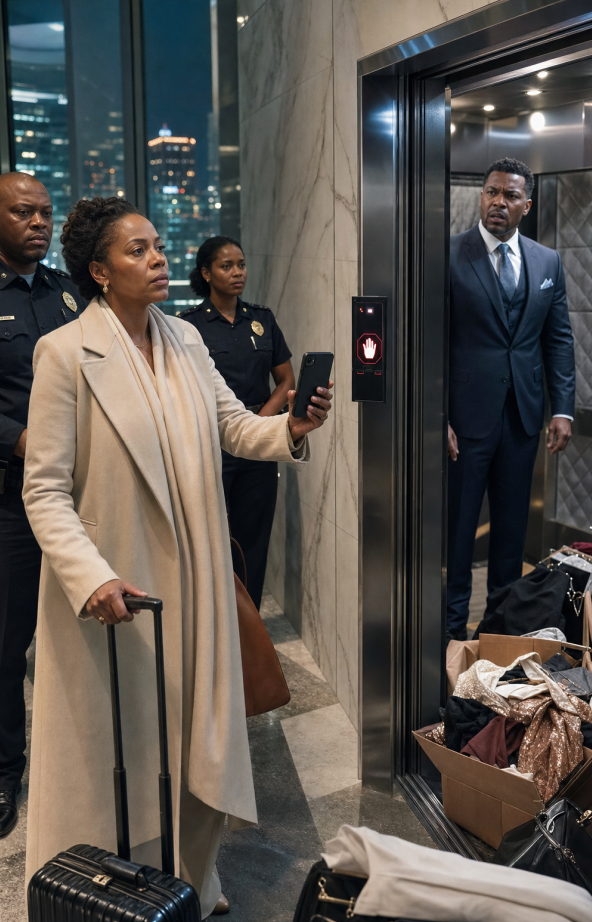
Then my father got sick, and then my father died, and I spent four days in another state burying the only person who’d ever seen me clearly. I came home in the same black dress, hollowed out, wanting nothing but my own bed. And I found my husband treating my grief as a window of opportunity.
The hallway was full of my life in boxes. Devin was red-faced and busy, hauling my suitcases toward the service elevator like he was clearing out a tenant who’d missed rent. Sabine — I hadn’t even known her name yet — leaned against the doorframe of the home I’d shared with him, arms crossed, already wearing the smug ownership of a woman who’d been promised the master suite. They didn’t even lower their voices. Devin told me I was a freeloader. That I’d contributed nothing. That the penthouse was his, the building was full of people who mattered, and I should take my boxes and disappear.
I want to be honest about the moment, because I’ve replayed it so many times. There was a version of me — the version from a week earlier — who might have crumbled right there in the hallway. But something about burying my father had burned the fear clean out of me. I had spent four days holding the hand of a man who spent his whole life quietly building a wall between the people he loved and the people who’d try to take from them, and here was one of the takers, hurling my dead father’s daughter’s clothes down a chute.
So I didn’t cry, and I didn’t argue. I opened the portfolio I’d carried up from the car — the one the estate lawyer had handed me the morning after the funeral, the one with the seal in the corner.
The first document in it was the deed to the tower. Not to our apartment. To the tower. Every floor, the lobby, the parking structure, the retail on the ground level, and the penthouse under Devin’s feet. My father had acquired the building eleven years earlier and folded it into the trust I now directed, alone, as of the reading of his will. The smart locks, the security desk, the elevators, the man who could cut a key card with two keystrokes — all of it answered to the entity whose seal Devin had ignored for a decade.
I didn’t wave it in his face. I’ve noticed that the loudest people go quietest when you simply hand them a fact. I turned the portfolio so he could see the seal, and I watched him recognize it the way you recognize a sound you’ve heard your whole life without ever learning its name. Sabine’s smirk was the first thing to go. Then the color in Devin’s face.
I made one phone call. I asked the building’s night security manager — a man who’d carried my father’s groceries and been to my father’s funeral — to revoke the access credentials on the penthouse for everyone but me, effective immediately, and to send someone up to reset the biometric lock.
It took about ten minutes. In that ten minutes Devin went from indignant to reasonable to frightened, cycling through every register a cornered man has. He tried “we can talk about this.” He tried “you can’t just.” He tried, God help him, “after everything I’ve done for you.” I let him talk, because I’ve learned men like him need to hear their whole speech before they’ll notice the room has changed.
Then the lock chirped and the keypad glowed and his card, when he swiped it out of reflex, did nothing at all.
Security escorted him out with Sabine and the boxes he’d packed of my things — which I told them to leave in the hallway, since they’d done the labor of packing them. I changed the lock, and I sat down on the floor of the home I owned, in the dress I’d buried my father in, and I finally let myself cry. Not for Devin. For the man who’d spent thirty years making sure that on the worst night of my life, one phone call would be enough.
The divorce was short. There is not much to argue about when the “his” home was never his and the “freeloader” holds the deed to the ground you’re standing on. Devin never did understand how it happened so fast. He’d spent nine years being certain he knew exactly who I was, and he’d been wrong about the only thing that mattered.
The seal on that folder didn’t make me powerful. My father did that, quietly, years before, in a language of trusts and deeds that a man too busy underestimating me never bothered to learn. All I had to do was open the cover.
Comments are closed.