The judge’s name was Harold Vance, and for the last four years of his life I drove him to his cardiology appointments every second Tuesday, because his own family couldn’t be troubled and because I liked him.
That’s the part nobody in my husband’s family could ever understand — that I did it because I liked him. Harold was ninety-one, sharp as a tack, meaner than a wasp to people who deserved it and unbearably gentle to those who didn’t. He’d been a state appellate judge for thirty years and a bank director for twenty more, and by the time I knew him he was mostly a very old man in a very quiet house who wanted someone to argue with about the newspaper. I gave him that. On Tuesdays I drove, and we argued, and afterward we got pie.
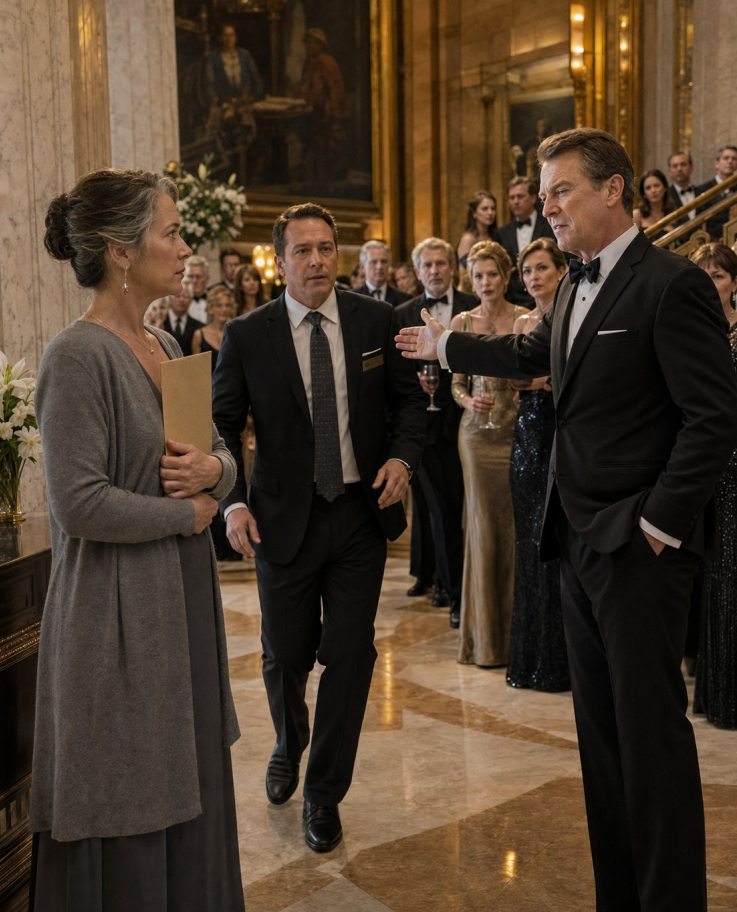
My in-laws knew none of this, because my in-laws did not ask me questions. To the Whitmores I was “the girl Michael married,” a caregiver, a nobody who’d gotten lucky. At the family’s charity gala — the big one, the one with the ice sculptures and the silent auction and the mayor — my mother-in-law introduced me to her circle as “our little helper, she does something with the elderly, isn’t that sweet.” Then she handed me her coat and asked me to find the ladies’ room attendant to have a stain seen to.
I took the coat. I’ve always taken the coat. It’s astonishing what people will tell you when they’re certain you don’t matter.
What none of them knew was that Harold Vance had died the previous Thursday, quietly, in the hospital I’d driven him to, with my hand on his and his daughter three states away and unreachable. And what none of them knew — what I myself did not fully understand until my phone rang in the middle of that gala — was what he’d done about it.
I stepped out onto the terrace to take the call. It was Harold’s attorney, a woman named Pruitt who I’d met exactly twice. She apologized for the timing. Then she told me that Harold Vance had, eighteen months before his death and in full possession of his faculties, rewritten his will to leave me his controlling block of shares in the Whitmore family bank.
I want to be precise, because the timeline is everything. The bank my husband’s family had run for three generations, the bank my brother-in-law was in the middle of leveraging into a hostile takeover of a rival, the bank whose board my mother-in-law bragged about at every dinner — that bank had a single largest shareholder, and it had been Harold Vance, who bought in during a crisis in the eighties and never sold. His shares were the swing vote. Whoever held them controlled the board.
He’d left them to his little helper. To the girl who drove him to the cardiologist. To me.
I stood on that terrace for a long time. Inside, through the glass, I could see my mother-in-law working the room in her borrowed importance, and my brother-in-law by the bar closing whatever deal he thought he was closing, and my husband — my kind, weak husband — trailing behind them the way he always did, hoping to be handed a piece.
I went back inside. I found my mother-in-law by the auction tables. And I did something I had never once done in six years of marriage: I asked her to be quiet for a moment, because I had something to say.
She laughed, of course. “The help has an announcement,” she said to her circle, and they tittered.
“Harold Vance died Thursday,” I said. “I was with him. You didn’t know I knew him. You’ve never asked me anything.” I let that sit. “He left me his shares in the bank. All of them. His attorney just called. As of this week I control your board.”
The tittering stopped.
I’d like to tell you it was triumphant. It wasn’t, really. It was mostly quiet — the specific quiet of a room full of people recalculating everything they’d said in front of someone they’d decided was furniture. My brother-in-law set down his drink and came over very fast, suddenly full of warmth, calling me by my first name for possibly the first time ever. My mother-in-law’s face did a complicated thing where thirty years of certainty tried to rearrange itself and couldn’t.
My husband just looked at me like he’d never seen me before. Which, I suppose, he hadn’t.
I didn’t wreck the bank. People assume that’s where this goes, that I fired everyone and salted the earth, but Harold would have hated that — he cared about the bank, and about the eight hundred people who worked for it, far more than he cared about the Whitmores. I blocked my brother-in-law’s takeover, because it was reckless and it would have cost those eight hundred people their jobs. I put two of Harold’s old colleagues on the board. I kept my seat and I learned the business, slowly, the way I’d learned everything, by showing up on the days no one thought I mattered.
My mother-in-law still doesn’t quite know how to speak to me. She tries “dear” and it comes out strangled. I don’t punish her for it. I just remember, every single time she does, that she once handed me her coat and told me to find someone to clean it.
I found something, all right. I found out exactly what an old man thought I was worth. It turned out to be considerably more than his own family ever guessed.
Comments are closed.