The colonel turned the medal over in his white gloves, and the whole hall went quiet in a way I will never forget.
I need to go back, though, or none of this makes sense. My name is Maggie. I was married to Sergeant First Class Daniel Reyes for thirteen years. We met at a laundromat in a town nobody’s heard of, and he proposed with a ring he’d paid for in installments, and he shipped out more times than I can count. Every deployment, I learned the same lesson over again: you love a soldier, you love the leaving.
We didn’t have the kind of marriage that shows up in photographs on a base. Daniel was private. He’d been burned before by people who liked the uniform more than the man inside it, so he kept our life small and ours. His unit rotated, his commanders changed, and somewhere in all that moving, the paperwork that should have listed me — his wife, his person — got tangled in a mess of old forms and a records office that had merged with two others.
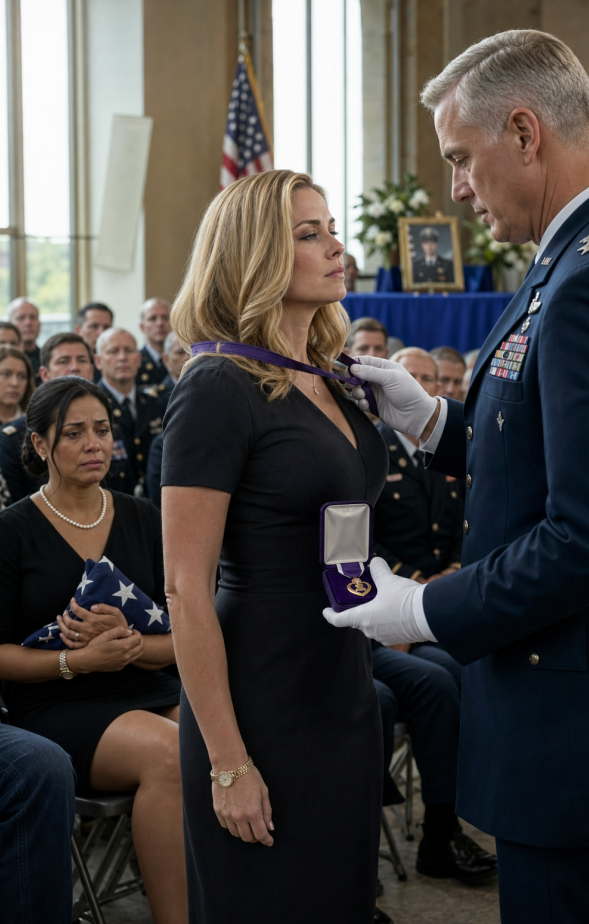
When the officers came to my door, they were kind. But there was already confusion. Another woman had come forward first. Denise. She had a story, she had documents, and she had something I didn’t: she’d been the one whose name landed on top of an outdated form that listed a “spouse of record” from years before Daniel and I ever married.
I tried to correct it. I brought our marriage certificate, our photos, our life. And the machine of grief and bureaucracy looked at a polished, weeping woman with paperwork and looked at me — quiet, plain, falling apart — and it made its choice about who looked more like a widow.
So on the morning of the memorial, I sat in the third row. Not the front. The third row. Holding the folded flag they’d handed me almost as an afterthought, because someone had finally, quietly, decided I was probably telling the truth but it was too late and too awkward to change the program.
I watched them lead Denise to center stage. I watched them speak my husband’s name over her. And when Colonel Whitfield lifted the Purple Heart in its velvet case and moved to lower the ribbon over her shoulders, I bit down on every scream in my body and said nothing. Because I had learned that a woman who makes a scene at a soldier’s memorial becomes the story, and I would not let anyone remember Daniel’s service as the day some hysterical stranger interrupted it.
Then the colonel paused.
He was seating the ribbon, adjusting it, and to do that properly he turned the medal so the back faced up. And on the back of a Purple Heart is engraved the name of the soldier it belongs to. His name. His rank. His service number.
I saw the colonel’s eyes move across that engraving. I saw him read it. I saw the exact half-second his training collided with something that did not add up — because whatever Denise had told them about who Daniel was, about their supposed years together, about the mission, none of it matched the man whose sacrifice was etched into the metal in his hands.
He straightened. He did not put the medal on her shoulders.
“Ma’am,” he said to Denise, and his voice had changed. “I need to ask you to confirm the service member’s designated next of kin and the date of the action for which this decoration was awarded.”
She started to answer. She got the date wrong. Not by a little. By a year and a country.
The colonel looked up, out over the hall, and his eyes found me in the third row with my folded flag.
“Is there a Margaret Reyes present?” he asked.
I stood up. My legs barely held me. “Here,” I said. “I’m here.”
What happened next I have replayed a thousand times. The colonel stepped down off that stage, crossed the whole length of the hall to the third row, and stopped in front of me. And this decorated officer, in front of every soldier and every family in that room, came to attention and saluted me.
“Mrs. Reyes,” he said. “On behalf of a grateful nation, and with my personal apology for this error, I present you the Purple Heart awarded to your husband, Sergeant First Class Daniel Reyes, for wounds sustained protecting three members of his unit during the action that took his life.”
Then he told the room what Daniel actually did. The thing Daniel never told me, because that was who he was. He’d pulled two of his soldiers out of a burning vehicle and gone back for a third when he didn’t have to, and he didn’t come back the last time. Three men are alive. Three families still have their sons because of the man a stranger tried to be the widow of.
Denise, it came out, had never met Daniel. She’d found his name on a casualty list, matched it to that outdated form, and built a claim — because a “surviving spouse” of a fallen service member is entitled to benefits and a service-member’s life insurance payout, and she had done this before, to another family, in another state. The investigators had been closing in already. My insistence, and one engraved medal, is what tripped the last wire.
I held that Purple Heart in both hands and I finally, finally cried, and not one person in that hall thought I was making a scene.
I let them put my husband’s medal on the wrong woman’s shoulders for exactly as long as it took the truth to speak louder than I ever could. Sometimes the quietest person in the room is the one holding the only thing that’s real. And the name engraved on the back of that medal was never going to fit anyone but the man I loved.
Comments are closed.