The woman in the black suit was named Ruth Halloran, and she was the estate lawyer for Adelaide Finch.
You wouldn’t know that name. That was rather the point of Adelaide. She’d written four novels under three different pen names across forty years, sold millions of copies to people who had no idea the three names were one silver-haired woman who wouldn’t do a photograph, and she’d spent the last two years of her life in a brownstone with the curtains half-drawn, mostly alone, mostly forgotten by the press that had once camped on her step.
Not entirely alone. There was a temp assistant the agency sent over to help her sort her papers. That was me. Three days a week that turned into most days, because the papers were an excuse and we both knew it, and what she actually wanted was someone to read to her and argue with her about endings and sit while she remembered things out loud. I never told the agency the job had changed shape. I just kept showing up. She called me “the girl,” the way she called everyone something other than their name, but she said it soft.
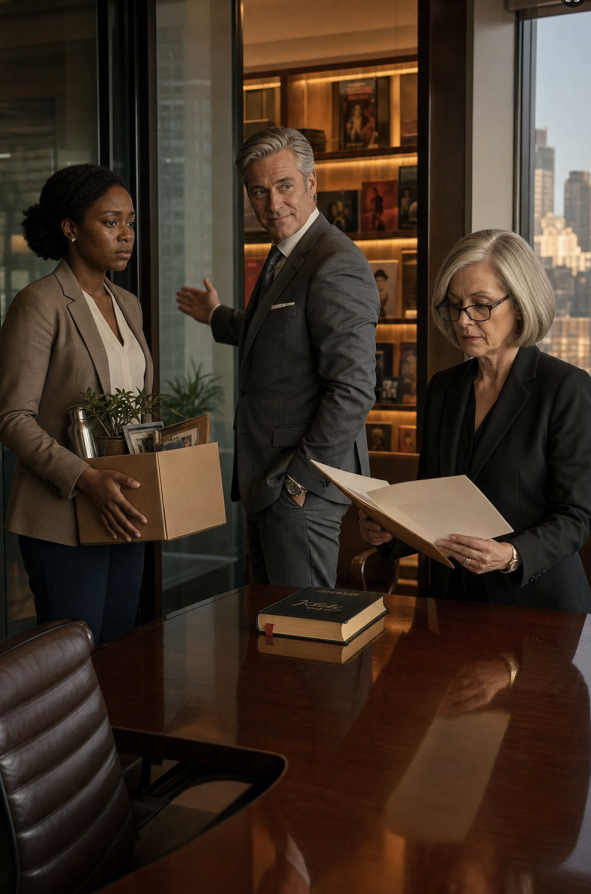
She died on a Tuesday. I found out from the agency, in an email, the way you find out a shift got canceled. And two weeks later I was standing in a boardroom holding a box of my own desk things while Nathan Pryce fired me mid-meeting to tidy up before he sold her press.
Ruth Halloran set her folder on the long table and did not sit down.
“I’ll be brief,” she said, “because Ms. Finch was brief, and she’d haunt me otherwise. Adelaide Finch held a controlling interest in this press. Fifty-one percent. She acquired it quietly over the last decade specifically so that no one could ever sell her work out from under her the way her first publisher did in 1974.” She looked around the table, at the executives, at Nathan, at the deal folder open in front of him. “That interest does not pass to this board. It does not pass to any acquirer. Per her instructions, revised and signed six weeks ago, it passes in full to Grace Okoro.”
The room did a thing I will remember for the rest of my life. It turned. Every face in that boardroom turned from Nathan to me, the girl by the door with the cardboard box, and I watched Nathan Pryce’s mouth open and close with nothing coming out of it.
“That’s not —” he started. “She’s a temp. She’s an assistant. Adelaide barely —”
“Adelaide,” Ruth said, “left a letter. Shall I read the relevant line?” She didn’t wait for permission. She never did, I’d learn. She slid on her reading glasses and found the place. “‘Give it to the girl who read to me. She’s the only one who ever asked what I wanted the ending to be instead of telling me what would sell.'”
I had to put the box down. My hands weren’t working right.
Here is the part I wasn’t prepared for, the part that no reversal in a boardroom fixes. I won. I stood there and I won everything — the press, the controlling stake, the power to stop the sale with a single word, the authority to fire the man who’d just fired me. Ruth handed me the folder and it was all true and all mine.
And the only person I wanted to tell was dead.
I kept thinking she’d want to know. That was the reflex. Something enormous happens and your mind reaches for the one person who’d understand it, and mine reached for a silver-haired woman in a half-dark brownstone, and she wasn’t there, and she was never going to be there again. She’d done this extraordinary thing for me — she’d seen me, when being seen was the whole thing I’d stopped hoping for — and she’d done it from a place I couldn’t send a thank-you to.
I didn’t fire Nathan that day. I know that’s the ending the room expected. I sat down at the head of the table instead, in Adelaide’s fifty-one percent, and I asked to see the terms of the sale he’d been about to sign, and I killed it in front of him, clause by clause, in the same calm voice I use when I’m trying not to cry. That was worse for him than firing. Firing would have let him leave. I made him stay and explain, line by line, exactly what he’d been about to do to her life’s work, to a room that now knew who actually held the pen.
He resigned within the month. I didn’t ask him to. Men like Nathan can’t stand working under someone they used to look through.
The press still runs. We’re small and we’re solvent and we do right by our writers, and there’s a framed first edition of Adelaide’s first novel on the wall of what used to be Nathan’s office and is now mine. I kept the pen name secret, the way she’d want. The world still doesn’t know the three names were one woman.
But I know. And on the hard days I sit in that office and I read the line from her letter again, the one about asking what she wanted the ending to be. I got the press. I got the power. I got the last word over the man who tried to erase both of us.
I just never got to tell her the ending she wrote for me was the best one she ever did.
Comments are closed.