I need to be careful how I tell this, because parts of it are still in front of a judge. But the wedding is public record, and so is what came after, and I’ve decided I’m done being quiet. Vivienne Ashford spent two years counting on quiet.
Let me back up.
My father died owing more than he ever earned. He was a bookkeeper for a construction firm, honest to a fault, and a long illness ate everything he had and then everything I had. When the Ashford family lawyer contacted me, I thought it was about the debt — some clerical thing. It wasn’t. It was an offer.
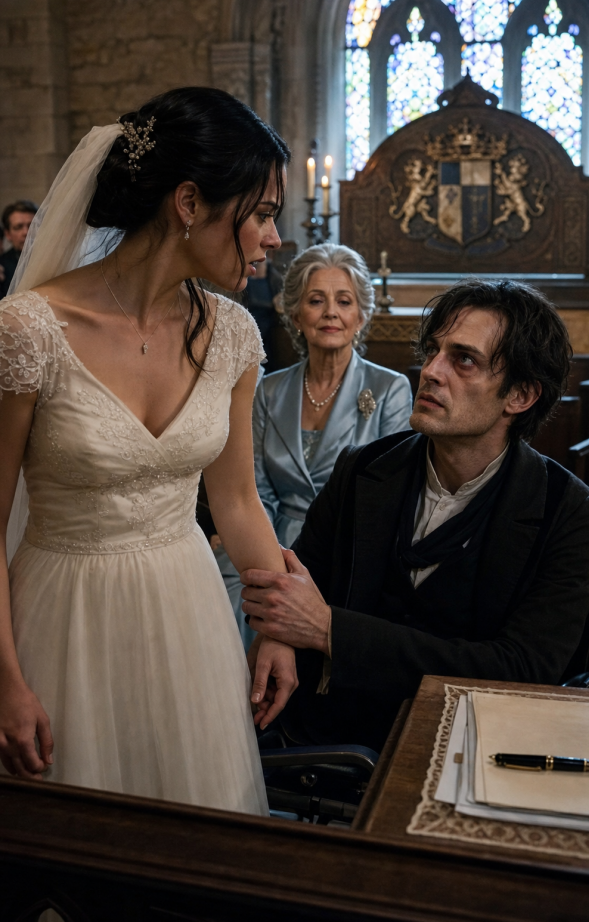
Marry Julian Ashford, the lawyer said. The family needed him married for reasons involving a trust that released on the marriage of the “primary heir.” In exchange, my father’s debts would vanish. Julian had had a stroke, I was told. He couldn’t speak, couldn’t really understand, wouldn’t even know the difference. I said no three times. The fourth time, the lawyer laid out how the debt collectors would come for my late father’s small house — the only thing of his I had left — and I said yes.
I met him twice before the wedding. Both times he sat in a wheelchair by a tall window, a nurse answering for him, Vivienne hovering and calling him “poor Julian” in a voice like sugar over ice. I felt sorry for him. I never once felt afraid. That was my mistake. I thought the frightening thing about that house was the silence. It was the woman who created it.
At the altar, when I leaned down and confessed I could never love him, I was being honest because I thought honesty cost nothing with a man who couldn’t hear. Then his hand caught my wrist and he spoke, and everything I believed about that chapel turned inside out in a single breath.
He talked fast, low, under the murmur of the guests. He’d had a stroke, yes — a real one, a small one, eighteen months before his father died. He’d recovered most of the way. But during that recovery, while he was still slow and slurring, his father had come to him, frightened, with something he’d found: Vivienne had been quietly draining the family holdings for years, moving money through shell accounts, and Julian’s father — her own son — had figured it out and was going to the authorities.
Two weeks later Julian’s father drove off a coast road in clear weather. The brakes, the report said, had failed on a car that was serviced monthly.
Julian tried to say something. He was still recovering, still hard to understand, and when he grew agitated and started insisting his father had been murdered, Vivienne had a specialist quietly declare him cognitively unfit — “post-stroke delusions.” She controlled his doctors. She controlled his money. She controlled the narrative. And Julian, watching what had happened to a father who spoke up, made a cold and terrible calculation.
He stopped speaking. On purpose. He let them believe the stroke had taken his mind, because a silent heir was useless to Vivienne but alive. A talking one was a threat. He’d spent nearly two years playing a man who wasn’t home, learning her routines, watching her lawyers, waiting for a mistake — and staying alive by being harmless.
The wedding was the mistake. Vivienne needed Julian married to release the trust, and then she needed his new wife — me — to sign an estate transfer “on his behalf” while he was legally incompetent. Once I signed, control of Julian’s shares flowed to her. And once she had everything, the two inconvenient people who technically stood between her and the whole fortune were a mute man nobody listened to and a nobody bookkeeper’s daughter with no family left to ask questions.
“After you sign,” he’d whispered, “we’re both just loose ends.”
I straightened up. I have never in my life been so aware of my own face. I looked at the pen on the papers and I looked at Vivienne’s serene smile and I said, clear enough for the front rows to hear, “I’d like a moment with my husband before we continue. Alone.”
Vivienne’s smile didn’t move, but her eyes did. I saw it. The first crack.
They wheeled us into the side vestry. The second the door shut, Julian gripped my hand again and told me where. A safe-deposit box, in a bank two towns over, under the name of his father’s old fishing buddy — a set of documents his father had mailed himself before he died, copies of the shell-account transfers, a letter naming Vivienne. Julian had memorized the location for two years and had no way to reach it, because he was never left alone and never allowed to be a competent adult.
I had something Julian didn’t. I was about to be legally his wife, and I was walking out of that chapel on my own two feet.
I did not sign the estate transfer. I told the lawyer I wanted my own attorney to review it — a completely normal thing for a bride marrying into money to say, and impossible for Vivienne to refuse in front of witnesses without looking like exactly what she was. We finished the ceremony. I smiled for the photographs. I kissed my husband’s cheek and felt his hand squeeze mine once, hard, which I understood to mean hold on.
Vivienne is not at the estate anymore. That’s as much as I can safely say while it’s before the court.
Julian speaks now. Slowly, still — the stroke was real, and some words come hard — but every day a little more. The first full sentence he said to me outside that house, in the sun, in a place his grandmother didn’t own, was, “I didn’t think anyone would ever hear me again.”
I married a man I pitied because I thought he was empty. He turned out to be the bravest person I’ve ever met — a man who played dead for two years to survive a murderer, and who used the last card he had, a forced marriage to a stranger, to finally save both our lives.
I told him at the altar I could never love him.
I was wrong about a lot of things that day. That was just the first.
Comments are closed.