I did not touch anyone. I want that understood, because of how the rest of it sounds.
I set my bag down inside the door of the ICU and I looked at the three of them — her father, her mother, her brother — arranged across the doorway to my wife’s bed like a fence, and I said, quietly, that I was going to see her now, and that they were going to move.
Her father said I had no right to be there. Her brother, who has never in his life done a thing that scared him, told me to leave before he called security. And I understood, standing there in four-month-old dust with my heart trying to climb out of my chest, that they had decided the story of what happened to Maddie was going to be a story with me in the villain’s place, and that they had gotten a head start on it while I was somewhere with no phone and no way home.
So I told them what I knew. Calmly, because calm is the only speed I have left in a room like that one.
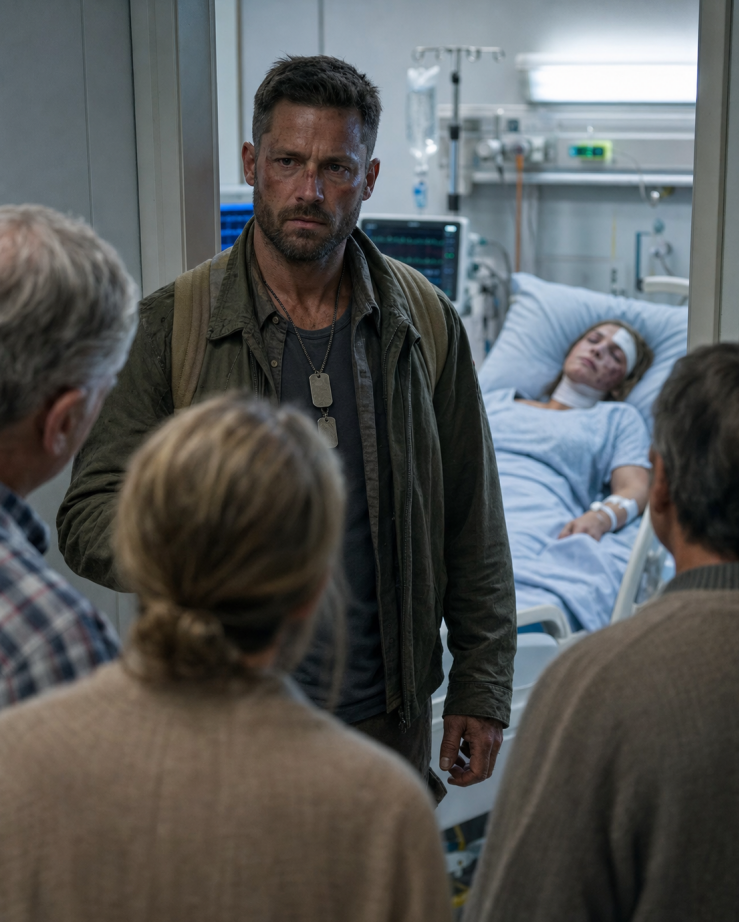
I told them I knew Maddie had not fallen down the stairs, which is what the chart at the nurses’ station said, because I had read it on my way in and because I know what a fall looks like and what a fist looks like and these were not the same. I told them I knew about the man she had been trying to get away from for the better part of a year — a man her family liked, a man with money and a good handshake, a man they had kept inviting to dinner even after she stopped coming. I told them that while they had spent that year deciding I was the problem because I was gone, someone else had been in the room with her, and it was not me, and some part of them had known and had chosen the easier villain.
The brother stopped talking.
I told them what I do. Not the details — I am not allowed the details, and they would not have understood them anyway. But enough. Enough for them to understand that the quiet man their daughter married, the one who never fit at the table, does a job that most people only see in the parts that make it to the news, and that the stillness they had read as weakness for years was the most dangerous thing in that hallway, and that I had spent it, all of it, on not raising my voice in a room where my wife was trying to heal.
And then I told them the last part, which was the part that moved them out of the doorway.
Maddie had called me. Once, weeks ago, on a line I am not supposed to be reachable on, and she had gotten twelve seconds through before it dropped, and in those twelve seconds she had told me the name of the man she was afraid of and asked me to come home. I had moved every mountain I am able to move to get there, and I had gotten there four days too late to stop what happened, and I was going to spend the rest of my life with those four days. But I had gotten there in time to make sure the man whose name she gave me would answer for it, because I had already made the calls that mattered before I ever walked into that hospital, and there were people on their way who were very good at making sure a good handshake and a lot of money did not turn into an escape.
The mother started to cry. The father stepped aside.
I went to Maddie’s bed. I sat down in the chair someone had left there and I took her hand, the one without the line in it, and I put my forehead down against her knuckles, and for the first time in four months I let myself stop being calm. She did not wake up right then. She woke up two days later, and the first thing she did when she saw me was try to apologize, and I told her there was nothing, not one thing, for her to be sorry for.
The man was arrested before she was discharged. Her family does not quite know how to look at me now — I am still the quiet one, still gone too much, but I am no longer the villain in the story they were writing, and something in that has made them careful with me in a way that is almost tenderness.
I do not need their apology. I needed the doorway, and they gave me the doorway.
People underestimate the still ones. They think quiet is the same as harmless, and gone is the same as gone for good. I came home from a place I cannot name to a room full of people who had decided who I was, and I taught them, without raising my voice, exactly how wrong the comfortable version of me had always been.
She is the only person I have ever protected who I could not protect in time. I will carry that. But I will carry it as her husband, in the chair by her bed, where I belong — and where, in the end, every one of them stepped back to let me sit.
Comments are closed.