Renata didn’t rush. She walked down that aisle the way a person walks when they have already survived the worst thing that will ever happen to them, and nothing in this room can touch them anymore.
She stopped beside the children and put a hand on the youngest one’s shoulder. The little girl, the one who’d spoken into the microphone, leaned into her mother’s side.
“Hello, Julian,” Renata said. “You look well.”
I want to explain something, because you deserve the whole ugly picture. When Renata and I were married, we tried for years to have a baby. Four specialists, three cities, thousands of dollars. The last doctor sat us down and said the word “infertile,” and he was talking about complications on her side, and God help me, I heard it as a life sentence for me. I wanted to be a father more than I wanted to be a good husband. So I left. I told our friends she couldn’t give me kids. I made myself the tragic figure. I moved across the state and I did not look back.
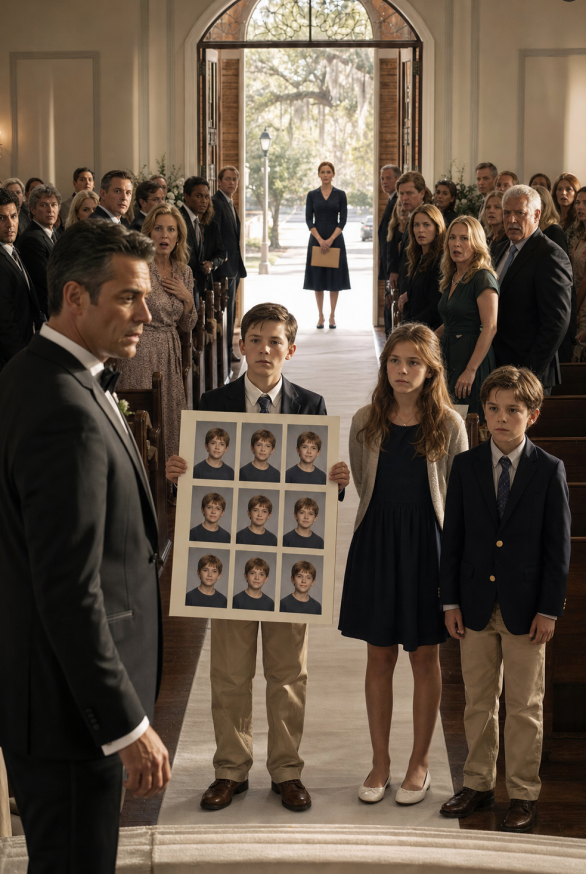
What I did not know, because I refused to answer her calls, was that the doctor had been wrong.
“I found out I was pregnant six weeks after you signed the divorce,” Renata said, loud enough for the front rows to hear. “You were already gone. I called. I wrote. I sent a letter to your mother. You changed your number.”
The boy with the poster board was watching me. All three of them were watching me. Nine school photos, three faces, my dimple stamped on every one like a signature I never meant to leave.
“Twins first,” Renata said, nodding at the two older ones. “Then a surprise, two years later, from the last time you came to sign the house papers and stayed the night. You don’t remember. You were already engaged to someone else by then.”
Whitney’s mother made a sound in the second row. I did not turn around. I couldn’t.
Then Renata held up the envelope.
“Six years ago I met a good man,” she said. “He raised these children. He coached the games you never saw, he sat up with the fevers, he is their father in every way that counts. He wanted to make it legal. Stepparent adoption. All it needed was one signature from you, relinquishing your rights, so he could take them on as his own.”
She pulled out the papers. They were creased, yellowed at the edges, stamped and re-stamped by a family court clerk.
“I mailed these to you three times,” she said. “Certified. You signed for the last one yourself. I have the green card with your name on it.” Her voice did not shake. “You never signed. Not because you wanted them. You told my lawyer, and I quote, that you ‘didn’t want your name on anything that could come back for child support.'”
The chapel was dead silent.
“So legally,” Renata said, “you are still their father. On paper, you are responsible for three children you have never met, whose birthdays you don’t know, who found your engagement announcement in the newspaper and asked me if they could come see your face. And you would not even give them the dignity of a signature so a better man could love them without you in the way.”
She set the envelope on the step at my feet.
“I’m not here for money,” she said. “The man who raised them makes a good living and a better home. I’m here because they asked me to be. They wanted you to look at them once. That’s all. Look at them, Julian.”
And I did.
I looked at the twins, who had my jaw and their mother’s steadiness. I looked at the little girl, who had stood at a microphone in front of two hundred strangers because she was braver at nine than I have ever been in my life. I looked at three children who did not need one thing from me, who had only come to be seen.
Whitney never made it down the aisle. I found out later she had heard the first sentence from the bridal suite and taken off her veil. She sent one text that night: “I can’t marry a man who could do that. I keep thinking about those kids’ faces.”
I signed the papers the next morning. I drove to the family court myself, and I relinquished my rights so the man who actually showed up could adopt them, and I did the one thing I should have done a decade ago. I got out of their way.
The last thing I have is a photograph. The court clerk offered to take one after the adoption was finalized, a formality, and Renata’s husband is in it with all three kids on the courthouse steps, everyone squinting in the Georgia sun.
I keep it in my wallet where a wedding photo was supposed to go. Not because I’m in it.
Because I’m not.
Comments are closed.