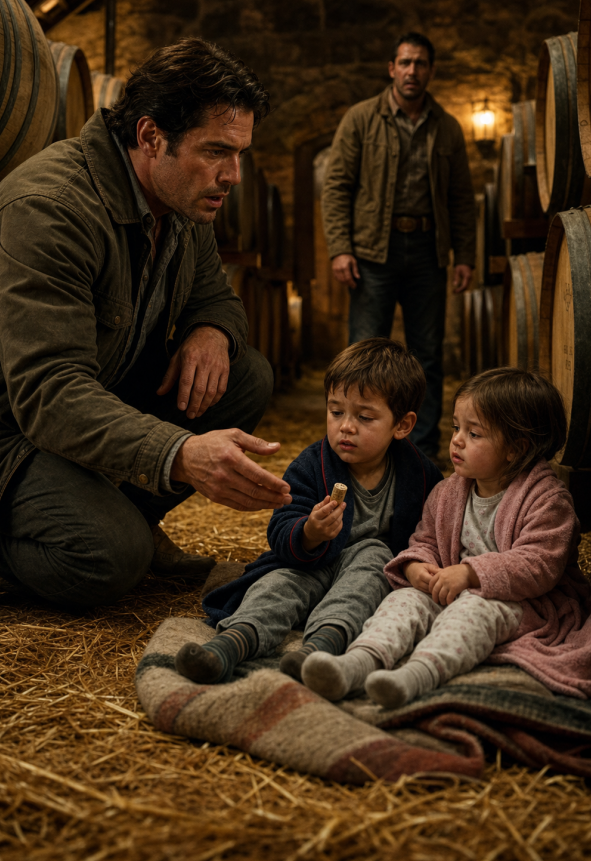
I didn’t touch them at first. I crouched there in the straw and the lamplight, close enough to hear them breathing, and I read the initials on the cork over and over as if they might rearrange themselves into something that made sense.
C.M.C. Clara Marie Cole. My wife. Who had been dead for two years.
The little girl woke up first. She looked at me with a calm that children have when they’ve been told exactly what’s about to happen, and she said, “Are you our dad? Mama said you’d find us in the wine place.”
I have run a large estate my whole adult life. I have negotiated deals that decided the futures of hundreds of people. I did not have a single word available to me in that moment. I just nodded, because it was the only true thing I could do, and both children accepted it with the total trust of kids who’d been promised this exact scene.
Their names are Sofia and Leo. They are four years old. They are, as a rapid and then a formal test would later confirm, mine.
To understand how they came to be asleep in my cellar, you have to understand my father, and what my marriage was actually like underneath the beautiful surface everyone saw.
Clara married into a family run, quietly and absolutely, by my father. He is a man who regards people as assets and affection as a liability, and he decided early that Clara was the wrong kind of wife — not from the right family, too independent, too unwilling to be managed. He made her life a slow, deliberate misery in ways that were always deniable. He controlled money. He controlled access. He made sure she understood that the family could make her disappear from my life whenever it chose, and that I was too much under his thumb, back then, to stop it.
What I didn’t know — what Clara hid from everyone, including me — was that when she got pregnant, she became terrified. Not of the pregnancy. Of my father. Of what a man who treated her as a problem would do about grandchildren he hadn’t approved and couldn’t control. She’d overheard things. Threats dressed as concern. Talk of “options” and “arrangements.” She became convinced, rightly or wrongly, that if she had the children inside our family’s reach, my father would find a way to take them, to raise them as Coles and erase her entirely, or worse.
So she made an impossible choice. She staged her death.
I won’t pretend I understand every mechanism of how she did it — there were people she trusted, a doctor, a long absence explained as travel, a boating accident with a body never recovered. I grieved her completely. I built a memorial. I was, for two years, a widower.
And the whole time she was alive, hidden, raising our twins in secret, waiting.
Waiting for what became clear to me only that night in the cellar: waiting for my father to die.
He’d been ill for a while. When he finally passed — three weeks before I found the children — the thing that had kept Clara in hiding was gone. The man she was protecting them from no longer existed. And so she began, carefully, to come back. But she didn’t walk up to my front door. She wasn’t sure, after everything, what I’d become in her absence. Whether I was still my father’s son or finally my own man.
So she tested me. She left our children in the one place that was purely mine, that my father had never cared about, that Clara and I had made our own in the early happy days of our marriage: the barrel cellar, where we’d stolen bottles and talked about the family we wanted. She stamped a cork with her initials so that even half-asleep, even without her there, I would understand the message. She was telling me she was alive. And she was trusting me to find our children and choose them.
She was in the village nearby that whole night, she told me later. Close enough to come running if anything went wrong. Watching to see what kind of father I’d be in the first thirty seconds, when no one was performing for anyone.
I passed. I’d like to think I’d have passed even if I hadn’t known she was watching.
Clara came home two days later. I won’t try to describe what it is to hold a wife you’ve mourned. There aren’t words that don’t sound like a greeting card. It was joy and rage and grief and relief all at once, and it took us months to even begin to untangle it. There is a lot of anger still — she took two years from me, and I have to keep reminding myself of the fear that drove her, and some days that’s easier than others.
But my father is gone. And the family he built to control us has no more power over anything. Clara and I are rebuilding, slowly, honestly, with a counselor and a lot of hard conversations.
And I have two children I didn’t know existed, who nap in the sun in the vineyard now instead of hiding in the dark of the cellar. Sofia still carries that cork around. She doesn’t know what it means yet. Someday I’ll tell her it’s the reason her father found her.
I thought I’d buried my whole family. It turns out my wife was just keeping them safe in the dark until the danger died first, and the light was safe again.
Comments are closed.