The ring said “For Nora, always,” and a date, and I had chosen every word of it at a jewelry counter in Duluth when I was nineteen and certain nothing could touch us.
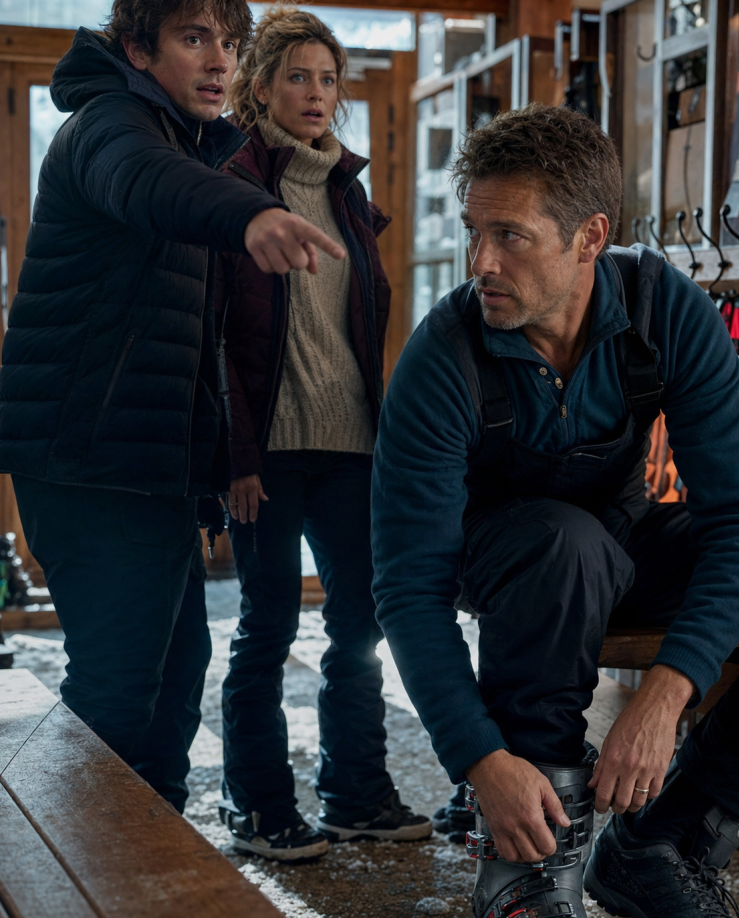
I made him take his glove off on the lodge steps. He’d tried three times to leave — mistaken identity, sorry ma’am, he really had to get back to a lesson — but Danny had planted himself in front of the man’s skis and would not move, and there is nothing on this earth as immovable as an eight-year-old who has recognized his father’s hands. So the instructor everyone at the resort called Erik sat down on the cold steps, and he peeled the glove off finger by finger, and he handed me the ring like he’d been waiting two years to be caught.
I read the inside. I already knew. But reading it in the daylight, in the wrong state, on the wrong man’s hand, broke something loose in me that the funeral never had.
His name was Michael. He was my husband. Two years earlier a ranger had come to our door and told me there’d been a backcountry avalanche outside a resort in Montana, that Michael had been guiding a private group off-piste, that the slide had taken him and two clients and that recovery in that terrain was not possible before spring. There’d been a report. A death certificate. A memorial with an urn I now understood held nothing but ceremony.
He told me the truth in pieces on those steps, with our son pressed against my side listening to every word, because I would not send Danny away and Michael did not get to decide otherwise anymore.
He’d been in debt. Not the ordinary kind — the kind that comes from borrowing against a guide business from the wrong people, the kind that had started arriving as men in the parking lot and phone calls that described our house and Danny’s school. He said he’d tried to fix it quietly. He said the day of the avalanche the slide had been real, that two men genuinely died, and that in the chaos and the impossibility of recovery he’d seen a door and walked through it. Let them count him among the lost. Let the debt die with a dead man. Start over three states away under a name he bought, and send money home anonymously when he could.
“I was protecting you,” he said. “They would have come for you if they knew I was alive.”
I have thought about that sentence more than any other. Because it is the sentence men use when they have made a decision for you and need you to be grateful for the grief.
Here is what protecting us actually looked like. It looked like Danny sleeping in my bed for a year because the house was too quiet. It looked like me learning to file life insurance paperwork with hands that wouldn’t stop shaking, cashing a payout on a man who was at that moment teaching rich tourists to snowplow. It looked like a little boy telling his second-grade class his dad died a hero in the mountains, and meaning it, and being so proud, while his hero adjusted bindings for tips and let him believe it.
The money had come, that part was true. Small anonymous deposits every few months that I’d credited to a survivor’s fund I couldn’t remember applying to. He’d been watching us from a distance the whole time. He knew Danny had grown. He knew I’d sold the guide business. He had chosen, over and over, every single month, not to come home.
I didn’t scream at him. I want you to know that. I’ve replayed it and I’m almost proud of how quiet I stayed, because Danny was watching and I refused to let this be one more thing that happened to my son instead of for him.
I asked him one question. I asked whether the men he owed still thought he was dead. He said yes. He said that was the whole point, that if he surfaced now it would undo everything, that we’d have to disappear too, that the safest thing was for me to take Danny home and let Erik the ski instructor keep on existing.
And that was the moment the grief finished turning into something else.
Because a man who faked his death to protect his family does not, when that family is standing in front of him, ask them to keep pretending he’s gone. A man protecting his family comes home and faces what he owes. What Michael wanted was not our safety. It was his second life, the clean one, the one without a mortgage and a scared wife and a boy who needed help with fractions. The debt had been the reason he left. It had long since become the excuse he lived inside.
I took the ring. He let me. I think some part of him understood he’d already spent it.
We drove home that night, Danny and I. I did not disappear. I did the boring, legal, un-cinematic thing: I called the insurance company, and then I called a lawyer, and I told them a dead man was teaching skiing in Aspen under the name Erik Lund and wearing a ring engraved to me. Insurance fraud is not romantic. It does not care about avalanches or protective intentions. The forged recovery report had names on it, and the people who’d signed it had a great deal to answer for.
Michael surfaced, in the end. Not on his terms. The debt he’d been so afraid of turned out to be far more survivable than the fraud he’d committed running from it — a fact I find grimly funny on the bad nights.
Danny asked me once, weeks later, if we were sad that Daddy was alive. It’s an impossible question and he’s a child, so I told him the truest thing I had: that we were glad his father was alive, and that being alive and being someone you can trust are two different things, and that he was allowed to feel both at once.
He nodded like that made sense. Kids understand more than we let them.
I kept the ring. Not out of love, exactly. Out of accuracy. “For Nora, always” turned out to be a promise he broke the first time it cost him something, and I wear it now the way you keep a receipt — proof of what a thing actually cost, and of the fact that I’m the one who ended up paying.
Comments are closed.