When the mayor of Dearborn, Michigan, boldly proclaimed that the name Abdullah Hussein Hammoud is as American as any other, he ignited a fierce national conversation. It is a debate that cuts straight to the beating heart of our republic: what does it truly mean to be an American in the twenty-first century?
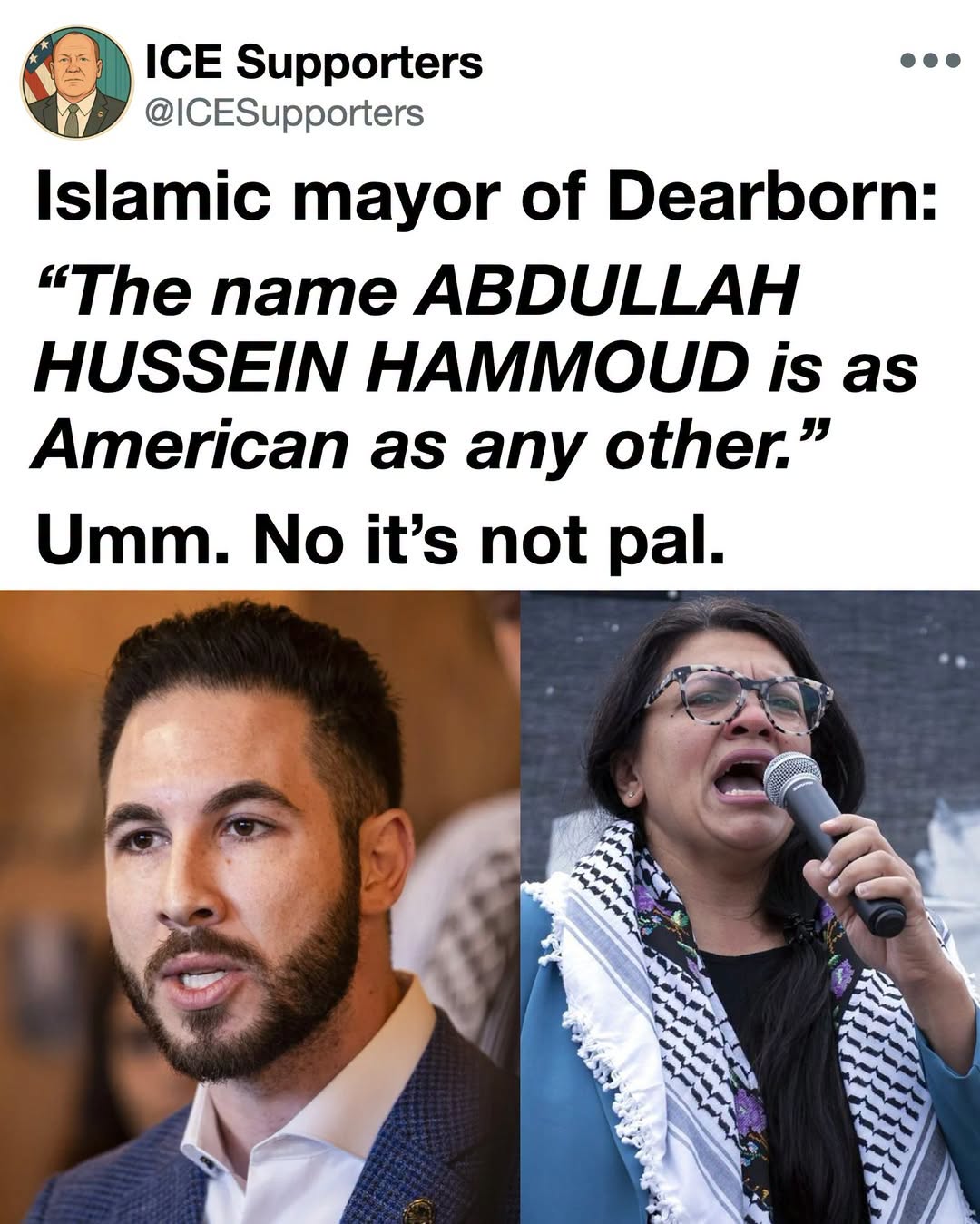
For generations, the United States has held its gates open to those willing to embrace its foundational creed, its legal traditions, and its shared cultural identity. Yet, the notion that American identity is infinitely elastic—stretching to accommodate any foreign tradition without requiring genuine integration—threatens to dismantle the very glue that holds this nation together.
Dearborn has long stood as a unique focal point in modern American sociological debates, serving as home to one of the largest Arab-American populations in the country. When Mayor Hammoud made his assertive declaration, it was not merely an expression of personal pride, but a deliberate political statement aimed at redefining the historic baseline of citizenship.
The core issue at stake is not the background of any individual, but the fundamental compact that has preserved American unity for over two centuries. A country is not simply an economic zone or an open border where disparate cultures coexist without common ground; it is a living, breathing civilization built upon distinct ideas.
When elected officials insist that every imported identity is automatically and instantly equivalent to the historic American one, they flatten the profound concept of national character. True citizenship has always demanded far more than just a piece of paper or physical presence within geographic boundaries.
The historic American model was never designed around the modern doctrine of fragmented multiculturalism, but rather around the time-tested principle of the melting pot. Immigrants from every corner of the earth arrived with diverse backgrounds, but they shared an overwhelming desire to become American in tongue, loyalty, and civic custom.
They learned the English language, internalized the principles of the United States Constitution, and actively wove themselves into the fabric of the existing culture. They honored their heritage in private, but their public allegiance was uncompromisingly devoted to the Stars and Stripes and the values of their new homeland.
Today, that essential expectation of cultural adoption is increasingly dismissed by political elites who favor unbridled globalism over national cohesion. By celebrating foreign naming conventions and political traditions as completely seamless with American identity, leaders risk encouraging parallel societies within our borders.
Names and identities that remain tightly bound to foreign religious systems and foreign political traditions often signal an incomplete journey of assimilation. When cultural enclaves operate with distinct legal norms, separate civic loyalties, and foreign flags, the foundational integrity of the republic begins to fracture.
A healthy nation openly welcomes newcomers who are eager to become American in substance, spirit, and everyday practice. It falters, however, when it asks nothing of those who arrive, allowing the host culture to be slowly eroded and fundamentally transformed from within.
The Perils of Cultural Fragmentation
Across the American heartland, millions of citizens are watching these cultural shifts with growing alarm and profound concern. They see city councils debating international foreign policy, municipal documents printed in foreign scripts, and local leaders prioritizing foreign grievances over domestic prosperity.
In Dearborn and several surrounding communities, political rhetoric has frequently mirrored the volatile tribal conflicts of the Middle East rather than the unified aspirations of the American Midwest. This imported factionalism creates deep divisions, isolating communities from the broader national narrative and eroding public trust.
The persistent emphasis on foreign identities and parallel cultural allegiances directly undermines the shared identity that binds over three hundred million people together. Without a common language, a shared historical narrative, and universal respect for Western legal traditions, no nation can long endure.
The United States Constitution was not authored in a cultural vacuum; it was forged by men steeped in English common law, the Enlightenment, and classical Western thought. To suggest that these timeless frameworks can effortlessly blend with competing legal and political traditions is to ignore the fundamental realities of history.
Treating every foreign designation as inherently and equally American effectively erases the vital distinction between ancestral heritage and active civic citizenship. While ancestral pride is natural, it must never supersede the overriding duty of undivided allegiance to the United States of America.
 Pennsylvania cop charged with manslaughter in fatal shooting of unarmed student: ‘Mr. Pysher was not a threat’
 Outrage Erupts After Illegal Immigrant Assaults NYPD, Walks Free Without Bail, and Mocks Cameras
 Nashua man Joel Page, accused of using AI to alter photos of a child he knew, faces felony charges
Critics of mass unassimilated migration point out that European nations have already run this reckless experiment with disastrous social consequences. From isolated suburbs in Paris to parallel legal structures in parts of Britain, the refusal to demand strict assimilation has fractured national unity across the Western world.
America cannot afford to repeat the catastrophic mistakes of Western Europe by surrendering its unique cultural heritage to fashionable political correctness. We must have the courage to declare that our national identity is precious, distinct, and worth vigorously preserving for future generations.
When municipal leaders use their public platforms to equate foreign traditions with historic American values, they send a damaging signal to newcomers. They suggest that joining the American family requires no sacrifice, no transformation, and no adaptation to the traditions of the host nation.
This mindset does a profound disservice to immigrants who have done the hard, honorable work of fully assimilating into American life. Millions of naturalized citizens have proudly adopted our language, embraced our laws, and raised their children to see themselves simply as Americans, first and always.
These dedicated patriots understand that the greatness of America lies in its ability to forge a unified people out of many distinct backgrounds—a principle immortalized in our national motto, E Pluribus Unum. Out of many, one; not out of one, many competing factions.
Preserving the Pillars of the Republic
True American belonging is not proven through political rhetoric or grandstanding at city hall press conferences. It is demonstrated day in and day out through faithful allegiance to the Constitution, mastery of the English language, and deep reverence for our nation’s founding principles.
The English language serves as the great unifying medium of our society, bridging economic, geographic, and generational divides. When we abandon the expectation of linguistic unity, we deliberately build barriers between our citizens and guarantee future social division.
Furthermore, our civic culture relies entirely on the universal acceptance of individual liberty, the rule of law, and the separation of religious decree from the civil government. Cultures that do not fundamentally embrace these Western liberties cannot simply be declared fully American by political fiat.
We must have an honest, unvarnished national conversation about the expectations we place upon those who seek to make this country their home. It is entirely just, moral, and necessary for a sovereign nation to establish clear standards for cultural integration and civic participation.
The United States remains at its strongest and most resilient when it expects newcomers to join its existing culture rather than dismantle or redefine it. A host nation that loses confidence in its own heritage and values will soon find that it has no heritage left to defend.
Mayor Hammoud’s comments reflect a broader, pervasive ideological push that seeks to redefine Americanism into an empty vessel devoid of any distinct character. If every foreign identity, custom, and political outlook is declared uniquely American, then the term ceases to mean anything at all.
The strength of our republic has never been measured by our willingness to dissolve our national character in the name of political expediency. Instead, our strength has always flowed from our unwavering commitment to our founding ideals, our constitutional heritage, and our shared way of life.
As we navigate an increasingly polarized world, the choice before the American people is remarkably clear and urgent. We can either demand robust assimilation and maintain a strong, unified nation, or we can embrace cultural balkanization and watch the fabric of our society unravel.
The legacy left to us by the founders of this great nation is far too valuable to be bargained away for the sake of progressive applause. True belonging in the American story requires an undivided heart, an absolute loyalty to our founding principles, and an enduring commitment to the land of the free.
It is time to reaffirm the timeless truth that being an American is a high and sacred calling, rooted in history, duty, and cultural unity. God bless the United States of America, and may we forever remain one nation, indivisible, under God.
No Comments yet!